

Google’s Page Experience Signals for Search Rankings Launches in May 2021

Your site's page performance will dictate its search viability

In May 2020, Google let the world know that its Core Web Vitals would become the new benchmarks for measuring a site's performance in its search results. Six months later, Google announced that its page experience signals will officially roll out and begin impacting search rankings in May 2021.

The page experience signals include Google's Core Web Vitals and existing search signals. Together, these will determine a website's page experience and overall site performance.


Google's Core Web Vitals include:

  • Largest Contentful Paint (LCP): A website's LCP is the time it takes to load the main content on a page. Google wants LCP to happen within 2.5 seconds of when a page first starts loading.
  • First Input Delay (FID): FID quantifies a user's experience when trying to interact with unresponsive pages. This usually occurs between First Meaningful Paint (FMP) and Time to Interactive (TTI) (more on what these two mean below). You want your FID score to be low to prove the usability of your site. According to Google, pages should haven an FID of less than 100 milliseconds.
  • Cumulative Layout Shift (CLS): CLS determines how often your users experience unexpected layout shifts or changes on a page. To ensure visual stability, you want your CLS score to be low. Google wants pages to maintain a CLS score of less than 0.1.

The other existing search signals are:

Together, all of these metrics determine Google's new page experience signals.

Google is planning to launch a visual indicator to let users know which search results have the best page experience. We know this will have a huge impact on user behavior. When Google first started adding the lightning bolt icon to AMP results on their mobile SERP, results in the middle of the page with the lightning bolt received much higher click rates than those without it. You can measure your site's page experience signals with tools like Google's PageSpeed Insights and Lighthouse 6.0 to determine if your site meets the new standards.
Get Your Site Ready for 2021

When Google first announced the timeline for page experience signals, there was plenty of chatter about this update being a search armageddon. But it certainly doesn't have to be. Google has provided plenty of warning about the new page experience signals because it's going to be a make-or-break determination for a lot of sites' SEO survival.

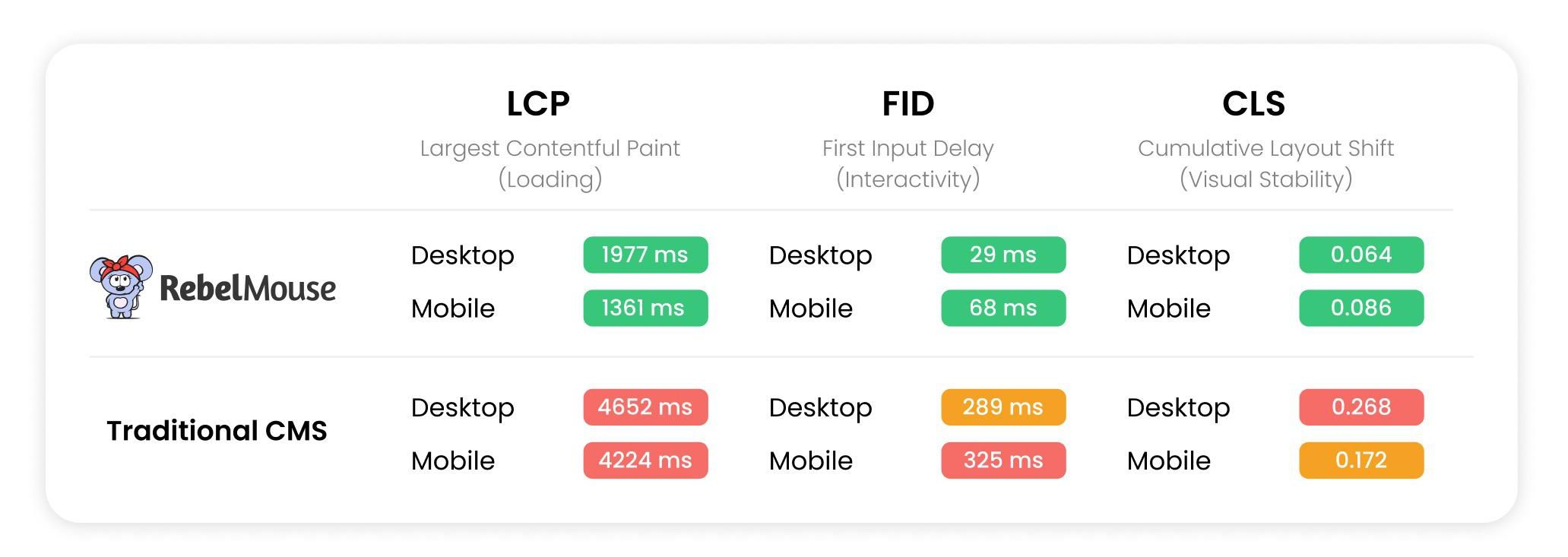
At RebelMouse, we've prioritized Core Web Vitals and Google's page experience signals for months. It's why we have some of the fastest sites on the web, particularly on the metrics that matter the most:

Click here for additional resources that detail our commitment to page speed. If you're not on RebelMouse and wondering how your site stacks up, request a free site audit with us. The audit includes performance measurements using tools like Google's PageSpeed Insights and Lighthouse 6.0 to determine if your site meets the new standards. Mention the audit when you request a proposal today. Let's make sure your site is ready for Google's page one.

Why RebelMouse Is the Best Content Marketing Platform

RebelMouse is a unique platform and company. The company was founded on the vision that media companies would need an always-modern solution to thrive in the new connected internet, and that brands would have to behave like new media companies and use the same platforms.

Keep reading... Show less

Why Premium Creative Agencies and CTOs Choose to Develop on RebelMouse vs. WordPress and Drupal

The Intersection of Design and Development: Where Your Clients Thrive

We started RebelMouse seven years ago knowing that there was a fundamental design flaw in the world of traditional CMSs: Every instance, on every platform, had to be updated independently. It's similar to an era when users had to manage their own Microsoft Exchange Server for email. The costs of managing, maintaining, and iterating on a CMS to keep it awesome and world class is typically a $10 million-a-year endeavor. But even then, these cost-prohibitive CMSs are still behind the times.

Keep reading... Show less

Native Multivariate Testing at Scale With RebelMouse

What Differentiates Our Approach

There are many popular tools that allow you to perform experiments and A/B tests on your users — primarily Google Chrome Experiments and Optimizely. But all of these solutions are JavaScript additions to your web page that sidestep the problem of old, outdated, and clumsy CMSs. These solutions work by calling on a third-party JavaScript library that rewrites a page after it's rendered. This approach adds extra page weight and creates strange user experiences due to having to wait for everything to load and be rewritten on the fly.

At RebelMouse, we've solved this in a very elegant way. At the core level of our platform, we can natively render different layouts and track the exact differences in performance when comparing a test to your other layouts.

Keep reading... Show less

Modern E-Commerce: Blur the Line Between Content and Design

Create Modular + Reusable Design Patterns on RebelMouse

Content saturation is an industry-wide problem, and the e-commerce space is no exception given that it's filled with big brands, small Etsy stores, and everyone in between all fighting for similar audiences. The best way to fight this symptom is to understand your audience and provide them with what they want.

Keep reading... Show less

Instagram-style E-commerce Features on RebelMouse

Revolutionizing E-commerce on RebelMouse

Whether you're a brand with a blog or a media company with a site, driving purchasing behavior and building an audience that uses your content to find things they love to buy is vital. We're very proud to have built out the same functionality that everyone is now used to on Instagram, with layovers on images that lead to products with attribution.

Keep reading... Show less

Building Premium Communities and User Journeys on RebelMouse

RebelMouse is much more than just a replacement for a traditional CMS. Our platform is a tremendous community-building experience. Today's social ecosystem has given us a seemingly limitless number of premium creators who understand how to create gorgeous and relevant content that drives the growth of their own audiences. These creators and influencers are either experts in certain topics, or heavily engaged in targeted content that drives their interests. They're not only consuming the content they're passionate about, but they're contributing to the conversation, too. The new role of the editor is not just to cover the most important topics and people around their expertise, but also to invite those preferred influencers into their community and get them to participate in creating premium content.

Keep reading... Show less

Dynamic Voting: Grow Traffic and Engagement Organically

Help your audience find its voice.

Creating quality content is no longer on marketers alone. We live in a universe of creators who are willing to not only consume content that resonates, but play a role in the creation, promotion, and conversations surrounding it.

Since the start of RebelMouse, we've been on a journey to create dynamic media that is easier for content creators to curate and amplify on social. It's why we've built an online engagement platform centered around the power of communities that thrive naturally in the digital ecosystem.

Keep reading... Show less

How to Monetize Your Website in Today’s Publishing Environment

In order to define distributive publishing, we have to ask the following question: If you have quality content, but nobody sees it, does it even exist? The answer is no, because your content needs to be supported in a way that lets it move seamlessly across all channels, especially site, search, and social. But let's take this question a step further: If you can't monetize your content to generate the support it needs, how do you create quality content in the first place?

Keep reading... Show less

Pro Tip: Too Many B Tests? Use Shared Elements for Better Organization

The RebelMouse platform offers unique multivariate testing that makes creating B tests for page layouts easy. However, sometimes having too many B tests can be hard for developers to organize and manage. If this is a problem on your site, you'll want to consider testing components of your site using shared elements. This helps your site's design workflow in a few ways:

  • Developers can work on different post layouts at the same time.
  • If you only want to process one B test, our servers will load all of them at the same time. Using shared elements prevents this from happening.
  • Our servers do not run shared elements if the conditional is set to false.
  • Post and Section pages will become more organized in Layout & Design Tool.
Keep reading... Show less

RebelMouse: The Healthcare CMS

RebelMouse is an industry-leading healthcare CMS that provides all the tools needed to create, maintain, publish, and distribute content on the web. Our platform has proven success with many healthcare-based sites. Indeed, the stats we have seen with these sites are nothing short of remarkable.

Keep reading... Show less

Google News Initiative Creates COVID-19 Vaccine Misinformation Fund

The Google News Initiative launched a new fund to battle misformation about the COVID-19 vaccine. The COVID-19 Vaccine Counter-Misinformation Fund is open to publishers all over the globe who reach audiences that are underserved by fact checking or targeted by misinformation.

Keep reading... Show less
Subscribe to Our Newsletter