
Google recently published a case study that highlighted the benefits of using structured data and optimizing URLs to improve crawling. The case study focused on video structured data in particular, and how it almost doubled clicks from search engine result pages (SERPs).
The case study is about an Indonesian publisher named Vidio that implemented video structured data best practices and saw significant improvements in search traffic and visibility.
Get Caught Up: What’s structured data? Structured data is a set of "clues" provided to Google’s crawler about what defines your content. Using schema, or a vocabulary you share with Google about every page on your site, you can tell Google’s crawler, Googlebot, the story of your content in human language. Click here to learn more.
Vidio Case Study: Implementing Best Practices
Vidio implemented all of Google Search’s best practices around videos, including the correct structured data markup.
There were two important attributes that Vidio used for their videos:
- The @VideoObject markup, which is a piece of code that tells Google’s crawler about each video, including the title, description, thumbnail, duration, and more.
- The @contentURL markup, which is a piece of code that points to an actual media object, which in this case was a video.
Then they tested each page with a video using Google’s URL Inspection tool, which determines if a page is correctly following all of its best practices.
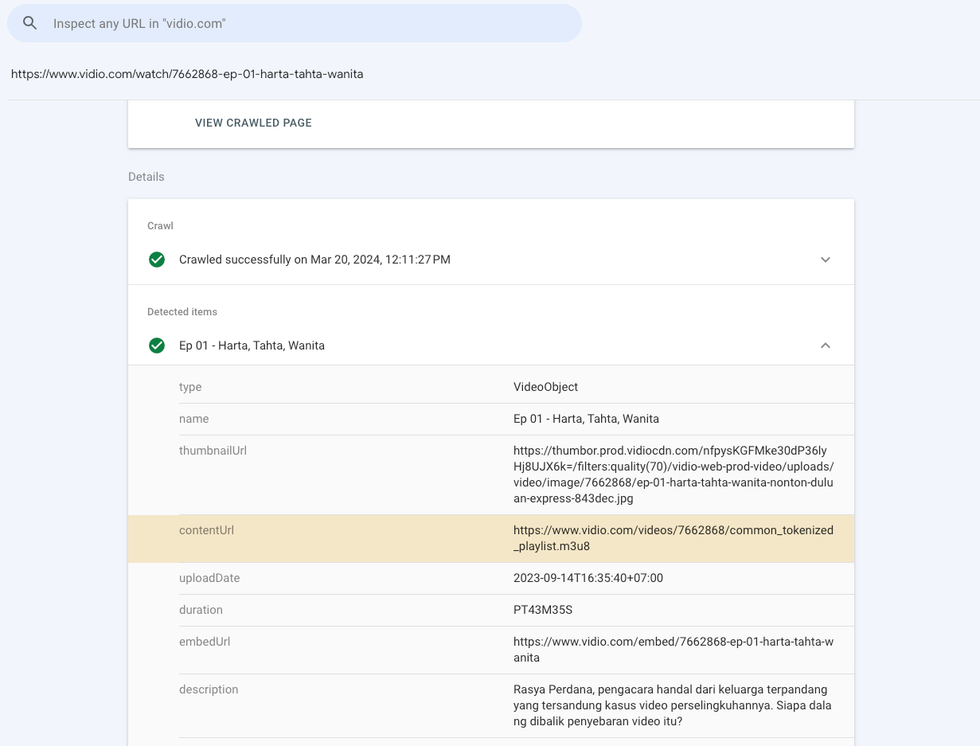 Vidio’s URL Inspection tool report. From Google.
Vidio Case Study: Importance of Stable URLs
In addition to implementing best practices, the case study highlighted the importance of stable URLs.
Wait, what’s a stable URL? A stable URL, also called a persistent URL, is a web address that always links to a specific source, in this case, a video.
Content delivery networks (CDNs) are systems of distributed servers that deliver web content and media to users based on their location to improve load time. However, sometimes they can sometimes cause indexing issues because they often use temporary URLs for video files. These temporary files make it hard for Google’s crawler to index the videos correctly.
Start doubling your traffic with structured data. RebelMouse can help.
Click HereUsing stable URLs for each video instead of these temporary files helped Vidio get their content indexed more quickly, and easy to recall again. Stable URLs also help Google better understand user interests over time, which helps to reduce the risk of broken links or other inaccessible content that could hurt your search rankings.
Vidio Case Study: Huge Lift in Search Visibility
While this case study only focused on video, it illustrates the importance of using correct structured data to improve search performance. Even if it seems like something small, like making sure that Google can efficiently crawl URLs linked to videos, it can move the needle on your site’s discoverability.
Google said that Vidio experienced almost double the clicks after implementing the correct structured data:
“Vidio saw improvements in impressions and clicks on their video pages. While the number of videos that Vidio published from Q1 2022 to Q1 2023 increased by ~30%, adding VideoObject markup made their videos eligible for display in various places on Google. This led to an increase of ~3x video impressions and close to 2x video clicks on Google Search.”
Get More Clicks From Search With Structured Data
If something as simple as making sure your site’s video structured data is implemented correctly can trigger such a big lift in your search performance, think about what it would be like if your entire site was optimized with the right schema markup.
To summarize, complete structured data helps your site have:
✅ Enhanced visibility
✅ Better search rankings
✅ Richer search result displays
But while the correct structured data may seem simple to developers and SEO experts, there is a huge learning curve for content creators who already have a lot on their plate. That’s why it’s important to incorporate technical SEO strategies like structured data into your publishing process from the start.
RebelMouse is an AI-enabled CMS that automatically implements key structured data so that Google can better understand your site. Our out-of-the-box integration populates all of the standard schema data with information about article content, and we’ll make sure other elements like videos have the right structured data in place, too.
Our structured data integration is just one of the ways we make sure the sites in our network are set up for maximum visibility across search. If you’re interested in learning more about how we can take your site to the next level and help meet your business goals, request a demo today and let’s start working together.


