


Many of today’s browsers now block third-party cookies. Therefore, leveraging first-party data enables advertisers to enhance their targeting capabilities, ensuring ads are shown to more relevant audiences.
This knowledge led us to hypothesize that implementing a taxonomy made specifically for advertising will lead to higher CPMs.
Sites usually have an editorial taxonomy of sections (or verticals) which are created so that their users can easily browse and navigate their content. For example, you may have a technology site with sections for artificial intelligence, renewable energy, biotech, etc.
While these types of taxonomies can sometimes intersect with dedicated taxonomies used in the advertising industry, in the majority of scenarios, that’s not the case. Having a secondary advertisement-focused taxonomy helps to improve ads targeting.
AI is amazing at streamlining various tasks, and the application of advanced models lets us automate the creation of this secondary, advertisement-focused taxonomy. By leveraging AI and utilizing first-party data to deliver the assigned taxonomy, website owners can enhance ad targeting, leading to improved CPMs through higher conversion rates, without disrupting the editorial workflow.
Project Overview
For this project we used the following tools/products: Google Ad Manager 360 (GAM 360), GAM API (application programming interface) to automate any bulk action items, and OpenAI (artificial intelligence tool) to analyze and map website content.
We decided to use the IAB's standardized audience taxonomy since it's the most relevant, and it's also accepted by GAM 360. Since we were unable to get demographic data from users, we decided to drop the terms associated with them and use only the ones related to interests and purchase intent.
Results: Significant CPM Growth
The results confirmed our hypothesis: Using AI to categorize a website’s content into a secondary taxonomy focused on the advertising industry did increase programmatic CPMs. See the final section of this article for the associated methods used in this experiment.
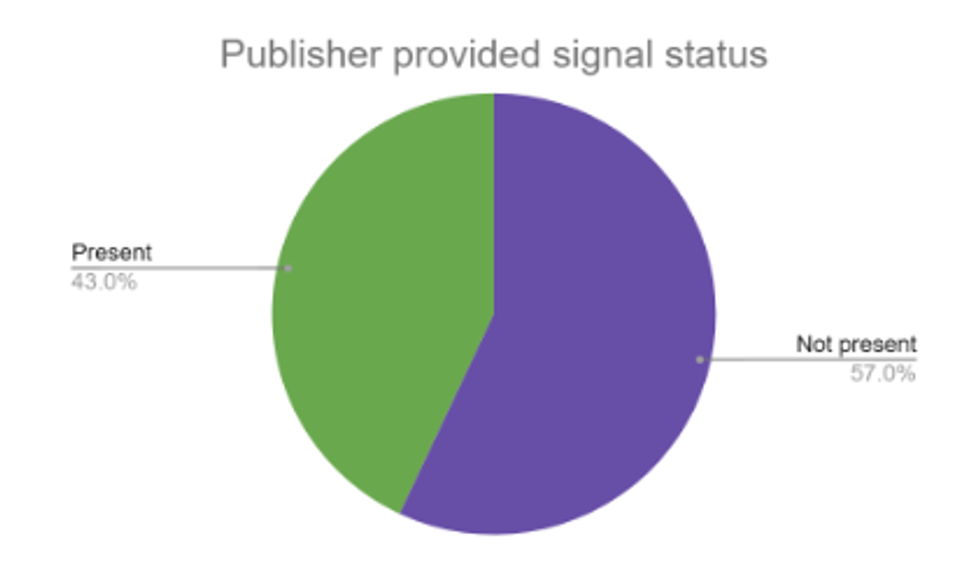
Publisher Provided Signals (PPS) are not sent from GAM to Google’s buy-side platforms on every ad request. The graph below shows the percentage of the ad requests with PPS present versus not present:
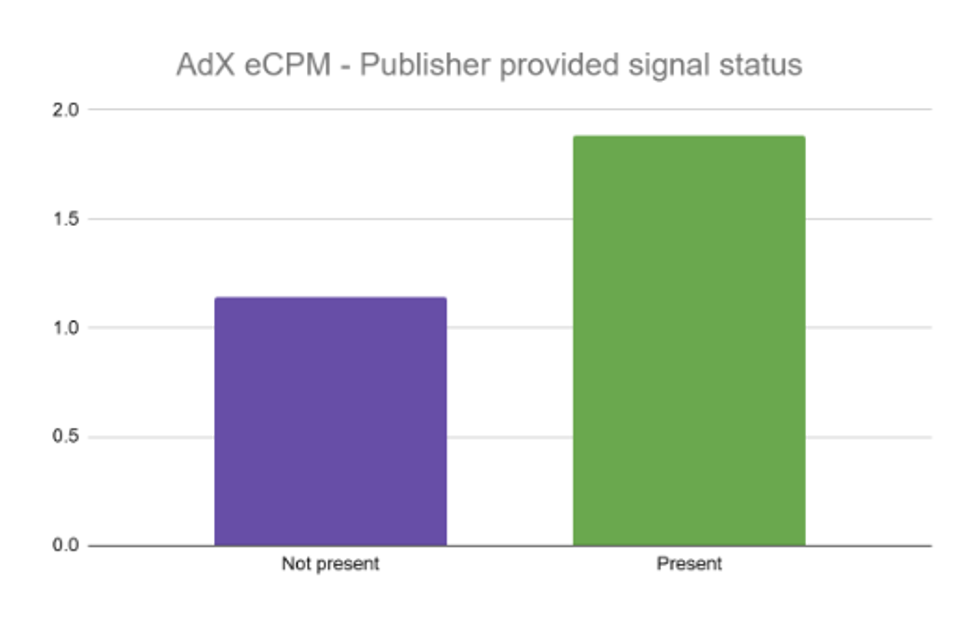
43% of ad requests included the taxonomy terms associated with the content the user had previously read (through PPS), while 57% of requests did not include them. With that in mind, whenever PPS was present, there was a significant increase in eCPM:
The eCPM in Google AdX rose from $1.14 up to $1.88, a 65% increase, which translated to an overall 27% revenue increase over roughly the past three months (January 1, 2025–March 23, 2025).
What's Next?
As we've shown above, that advertisement-focused taxonomy can help to increase CPMs across programmatic ads, we're excited to extend this implementation to more of our existing clients. We also believe the obvious next step is to apply the same methodology toward direct-sold campaigns.
Using an advertisement taxonomy focused on a specific industry and/or an IAB taxonomy to classify content consistently will make it easier for ad sales teams to match their direct-sold campaigns with the right audience on their websites.
Benefits for Ad Sales
By using the GAM forecasting tool, advertisers can determine the available ad inventory for each advertisement taxonomy item. This helps with campaign planning and future delivery. The inventory volume of each taxonomy item offers valuable insights into website audience interests and content, making it a crucial component for developing a comprehensive media kit.
Enhanced Ad Relevance
Ads that match up to standardized content categories are more likely to resonate with users, improving engagement rates and overall campaign performance. The idea is to improve click-through rates (CTRs) of direct-sold campaigns with properly targeted ads, leading to higher conversion rates.
With better-targeted ads and improved engagement, publishers can achieve higher CPMs, boosting their advertising revenue.
Deeper Dive on Setup and Methods
This was a very detailed experiment that involved many team members and carefully planned-out strategies and tactics. Below is a brief description of the overall steps taken to reach our outcomes:
- Each IAB taxonomy item needs to have a matching first-party audience (FPA) created in GAM.
- Each FPA was assigned to the matching PPS in GAM. PPS lets publishers scale their first-party audience and contextual data to improve programmatic monetization. This helps publishers make the most of their first-party data for ads personalization in programmatic transactions, and helps buyers understand the inventory they're bidding into.
- Users were identified using publisher provided identifiers (PPID), which allows publishers to send GAM an identifier unique to a user without using cookies.
- Each user's PPID was assigned to the appropriate FPA based on the taxonomy terms associated with the articles they viewed.
- We implemented automations that trigger whenever an article is published. These automations send the article's headline and body content, along with the IAB's audience taxonomy, to an AI service, requesting it to return the relevant taxonomy terms for the article. The identified terms are then stored in the article's metadata.
- That automation was manually triggered for all existing articles so that all of them would have their matching IAB audience taxonomy terms embedded.
- Each time a new user visits the website, a “profile” in the form of PPID will be created, which will track their interests and purchase intent information. Upon their return to the site, we will be able to recognize the user and target personalized ads accordingly. Additionally, relevant user data will be shared with programmatic buyers through PPS. If the user displays new interests or purchase intent, those new signals will be included in updated FPA segments based on their activity on the website.
Interested in getting started? Get in touch with us today.


