

Google updated its publisher guidance on October 1, 2026, and the change is bigger than a routine policy tweak. Google is now telling sites to manually verify the accuracy of AI-generated content before publishing it. Manual fact-checking and review of AI content is no longer optional guidance. It's an expectation from the search engine giant, and it applies whether the content came from an outside vendor, an in-house tool, or an agent running inside your CMS.
The requirement doesn't stop at body copy, either. It extends to titles, metadata, and alt text. Every surface an AI model touches across your content now needs a human checkpoint before it ships.
The Requirement Covers More Ground Than Most Workflows Do
Most newsroom review processes were built around one assumption: A human writes the draft, an editor reads the draft, and then the draft publishes. AI breaks that assumption. The output isn't just the article body anymore. A model can generate the headline, write the meta description, draft the alt text for an image, and suggest the social caption, all in the same pass, often faster than the editor even opens the piece.
Google's guidance means every one of those outputs needs the same scrutiny the body copy gets. If your review process only checks the paragraphs and waves the metadata through, the gap in your compliance has your name on it.
Fixing it means building a system that stops every agent output before it reaches a live page, because telling editors to be more careful won't do it.
The Approval Inbox Is the Answer
This is the part we'd like to point to first: RebelMouse's agentic CMS was built around this mechanism, well before Google wrote it into publisher guidance.
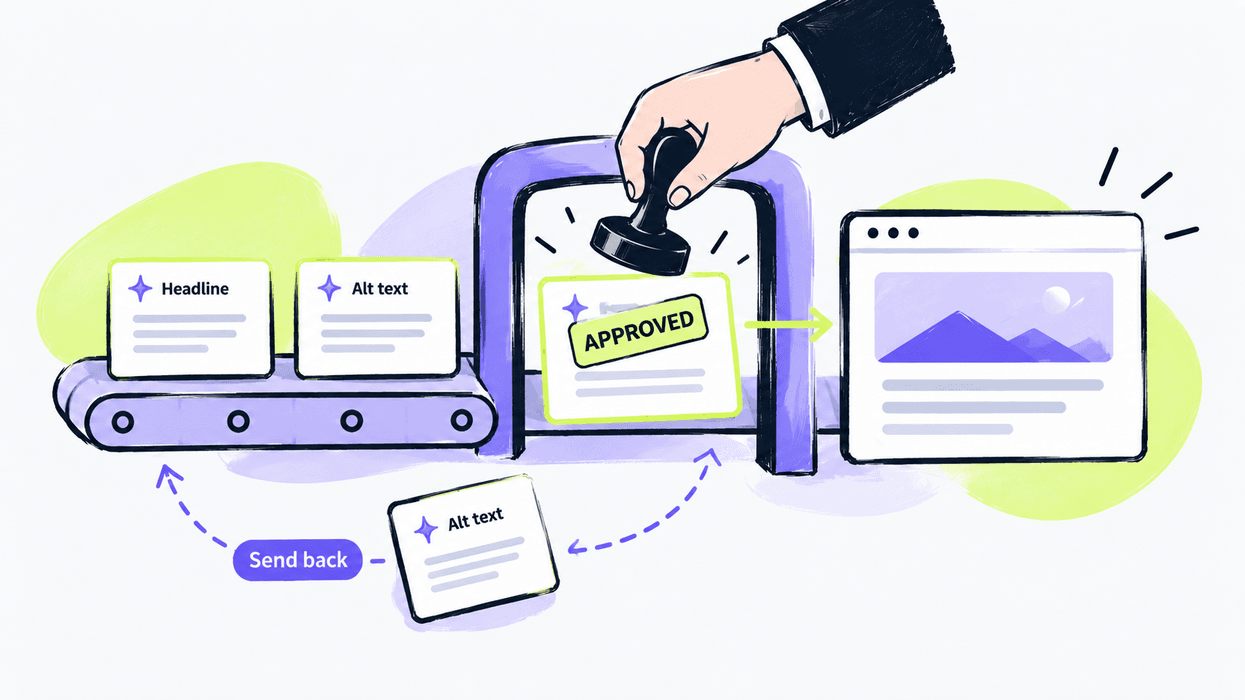
The model is simple. AI agents initiate and complete work instead of waiting for a human prompt, drafting, tagging, writing alt text, and suggesting headlines. But nothing goes live on its own. Every agent-produced output lands in an approval inbox, and a human has exactly one job at that point: Approve it or send it back. People approve outcomes instead of operating tools. The mental model flips from make the thing to approve the thing.
That one-decision structure is what Google is now asking every publisher to build, by hand, across titles, metadata, and alt text, on top of whatever CMS they already run. We didn't build this in response to Google’s guidance. We built it because we'd already concluded that the risk across agentic publishing wasn’t the AI's output quality. It was whether a human looked at that output before it went live. Google just turned our bet into a compliance requirement for everyone else.
We've written before about why we bet on AI inside our own walls before selling that bet to anyone else, and the approval inbox is the clearest product of that period. It's also why we describe the platform as four systems, one agentic CMS, rather than another AI tool bolted on top of a traditional publishing stack. Create, optimize, monetize, and automate all run through the same operating layer, and that layer is where the approval decision lives.
The Staffing Problem Behind the Workflow
The compliance question Google raised goes beyond whether a human sees a given piece of content before it publishes, down to which human, and whether they have the bandwidth to actually look.
That's a staffing problem as much as it’s a tooling one, and it's the piece most publishers haven't solved. Our staffing model for agentic work puts humans first, matched by skill and auto-suggested, with AI agents filling any gap in the workforce. People stay in the loop either way. The real goal is making sure the right person is always available to make the call, instead of one overworked editor becoming the bottleneck for every AI-generated title, caption, and metadata field a newsroom produces in a day.
Governance habits like this compound. We've made a similar case about crawl and governance controls for AI crawlers. Publishers that already had structure in place won't need to scramble when a platform tightens its rules.
Google Is Asking for Rigor It Hasn't Built Itself
Google is asking publishers to manually verify content accuracy while its own measurement tools are struggling to tell publishers what's happening to their content in AI search. We've covered how Google admitted its Search Console AI data is inadequate for understanding AI-driven visibility. The company asking for more manual rigor on the publishing side hasn't yet given publishers reliable automated visibility into the AI-search side.
That gap doesn't cancel out the new requirement, however. If anything, it strengthens the case for owning your own verification workflow instead of waiting on a platform to hand you the tooling.
The Checklist Hiding Inside "Manually Verify"
"Manually verify the accuracy of AI-generated content" sounds like a single instruction. In practice, it's five or six separate checks stacked inside one approval:
- Does the headline accurately represent the article, or did the model oversell it for clicks?
- Does the meta description match what the piece actually argues?
- Does the alt text describe what's actually in the image, rather than a plausible-sounding guess?
- Do the structured data fields a model touched (e.g., author, date, category) still point to the right facts?
- If the piece cites a source, does that source actually say what the draft claims it says?
None of those checks are hard on their own. The problem is volume. A newsroom running agents across dozens of posts a day can't run five manual checks per post without a system that surfaces every one of them in the same place, tied to the same piece of content, waiting on the same decision. That's what an approval inbox is for. Each check becomes a line item in front of the person approving instead of a mental list they're supposed to remember on their own, post after post, all day.
There's a second layer underneath the checking itself, too. Being able to show it happened matters just as much as doing it. An approval inbox handles that by default, because the inbox doubles as a log. Every decision, who reviewed it, what got approved, what got sent back, lands on the record automatically. If a platform or a legal team ever asks how a specific headline or alt text got cleared, the answer is a timestamp and a name, not a shrug.
What the Humans Are For
AI makes execution abundant. A model can draft ten headline variants, write alt text for forty images, and tag a week's worth of posts before an editor finishes a coffee. That abundance is real and valuable. What stays scarce is judgment. Deciding whether a given output is accurate, on-brand, and ready for a reader to see still takes a person, every time.
Google's guidance isn't a verdict on whether AI-generated content can be trusted. It's a reminder that execution and verification are two different jobs, and only one of them got cheaper.
The publishers who come out ahead will be the ones whose humans sit at the decision point for every single output, built into the CMS itself rather than left to a policy memo someone has to remember to follow.
As of October 2026, that structure is table stakes for any publisher running AI agents in production. Google just said so. We’ve already built it.


