

A New Kind of Audit Shows up in a Familiar Tool
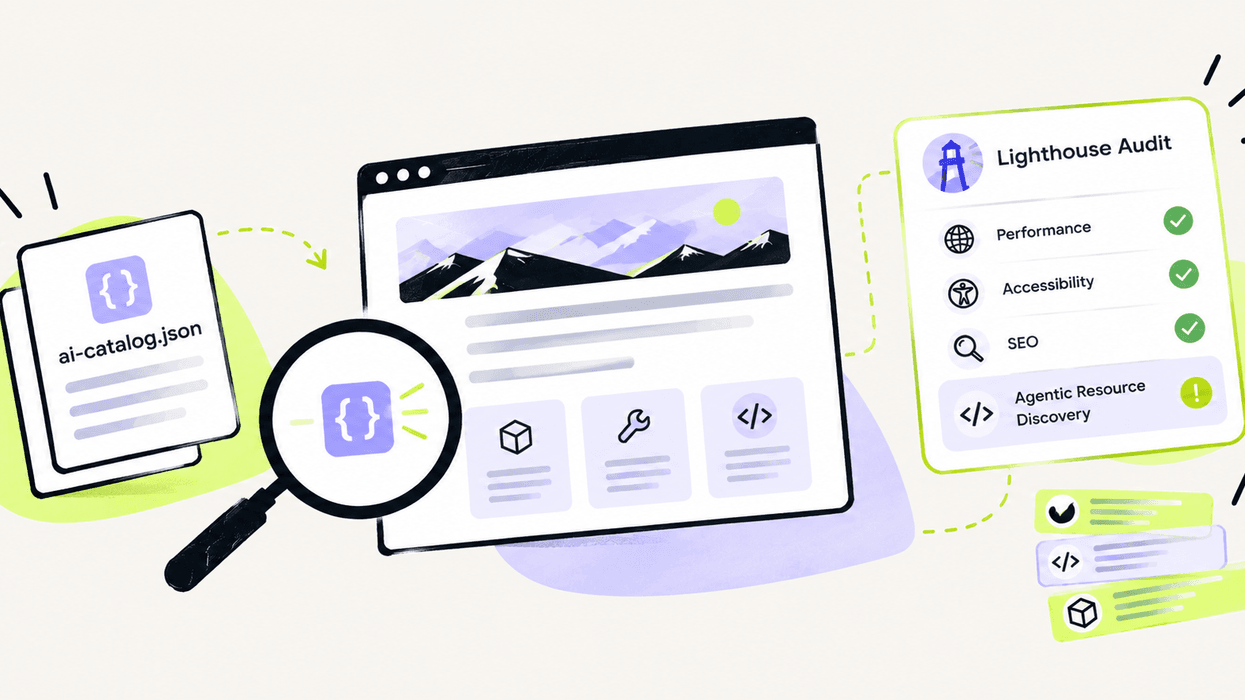
Lighthouse has been the default way developers check a page's speed, accessibility, and SEO basics for years. With version 13.5, Search Engine Journal reported that Lighthouse added an audit validating "Agentic Resource Discovery" catalogs that help AI agents find a site's tools, services, and available actions. If your site doesn't publish one, or publishes one that's malformed, Lighthouse will now tell you.
It’s a small technical change with a much bigger implication. Google has built a checker for something most sites have never heard of, which means Google expects "agent legibility" to become a real, measurable requirement.
What "Legible to Agents" Actually Means
For twenty years, being findable online meant being findable by a search engine crawler that indexes pages for a person who reads them. An AI agent acting on someone's behalf is a third kind of visitor, and it doesn't read a page the way a person does or index it the way a search crawler does. It needs a structured, machine-readable answer to a narrower question: What can be done here, and how do I do it? For example, a restaurant's site needs to tell an agent it can check a reservation. And a publisher's site needs to tell an agent what content exists, how it's licensed, and whether it can be summarized, cited, or must be linked to directly.
A catalog file is one concrete way to answer that question, but the underlying shift is broader than one file format. Sites are being asked to describe themselves twice: Once for humans, in prose and design, and once for agents, in a format built for parsing rather than reading. Most sites have only ever done the first one.
Think about how differently the two visitors behave. A person lands on a page, scans a headline, and maybe reads three paragraphs before deciding whether or not to stay. An agent doesn't scan. It queries. It's looking for a specific, structured answer to whatever its user asked for, and if that answer isn't available in a format it can parse, the agent doesn't slow down and read the prose version the way a person would. It just moves on to another site that made the structured version available.
Why This Connects to a Problem Publishers Already Have
We've written before about the governance side of this shift, in our Robots.txt guide, which covers how to control which crawlers and agents can access a site at all. That's the access-control layer that determines who's allowed in. This Lighthouse audit is checking something further downstream. Once an agent is in, can it actually find and use what your site offers, or does it hit a dead end because nothing tells it where to look?
Those are two different failure modes, and a site can get one right while completely missing the other. A publisher might have airtight crawler governance, blocking unwanted bots and allowing known agents through cleanly, and still fail this new audit because nothing on the site tells an arriving agent what's actually available. Access without legibility is a locked door with no sign on it. The agent got past the lock and still doesn't know which room to walk into.
The Parts of This That Are Easy to Get Wrong
A few specific failure patterns are worth checking for directly. A catalog file that exists but is out of date will actively mislead an agent rather than simply doing nothing, which is arguably worse than not having one. A catalog file with vague or generic descriptions of available actions gives an agent nothing useful to match against a user's request. And a catalog file that isn't kept in sync with the site's structure, updated only when someone remembers to, will drift out of accuracy the same way an old sitemap does, quietly, until something breaks downstream.
There's also an ownership problem hiding in this list. A sitemap usually has a clear owner somewhere in an engineering or SEO team. An agent catalog file is new enough that most organizations haven't decided whose job it is to keep it current, which means the likeliest outcome, absent a deliberate decision, is that nobody's job includes it. That's worth fixing before the file goes stale rather than after an agent has already been sending users bad information based on it.
This is the same discipline that structured data has always demanded, just applied to a newer format. We covered the mechanics of getting structured data right in our Structured Data for Companies: A JSON-LD Implementation Guide for 2026, and the lesson transfers directly. A machine-readable file is only as good as the process that keeps it accurate, and that process has to survive redesigns, new sections, and departed employees who used to own it.
What to Check Now
Run your site through an updated Lighthouse audit and see what it reports for agentic resource discovery. If nothing exists yet, that's not an emergency, but it is now a gap that a standard tool will flag every time someone checks. If something exists, verify it actually reflects your current site: the content categories, the actions available, and the licensing terms, all matched to what's live on the site rather than what was true when the file was first created.
Pair that check with a look at what we outlined in our AI visibility guide, because agent legibility and citation-worthiness are related but distinct problems. One is about whether an agent can find and use what you offer. The other is about whether an AI system considers your content worth surfacing in an answer at all. Sites that only solve one of these are still leaving value on the table.
The Pattern Underneath the Audit
This is a part of a broader pattern that's easy to miss if you're only watching one announcement at a time. The infrastructure of the web is quietly growing a parallel layer built for machine visitors, alongside the layer built for human ones.
- Robots.txt governs access.
- Structured data governs comprehension.
- Agent catalogs govern discoverability of actions.
None of those are optional anymore if agents are going to be a meaningful share of how people interact with your site, and each one requires the same thing: someone whose job is to keep the machine-readable version of your site as accurate as the human-facing one, on an ongoing basis, not as a one-time project.
None of this is really about chasing a Google checklist item, even though a Lighthouse audit is what surfaced it publicly this time. It's about a simple fact that's easy to lose track of while everyone argues about AI Overviews and citation counts. A growing share of your traffic is going to arrive by way of an agent acting on a person's behalf, and that agent is going to make a judgment about your site in milliseconds, based entirely on whether it could find a structured answer to what it needed. A beautiful page a person would enjoy reading is invisible to that agent if nothing machine-readable backs it up.
That's infrastructure work, not content work, and it tends to fall through the cracks between technical and editorial teams because it belongs to neither one cleanly. Whoever owns technical SEO at your organization needs this on their list now, before the audit that catches the gap is a competitor's advantage rather than a Lighthouse warning only your own team sees.


