
Key Takeaways
Curiosity led, not a mandate.
The momentum started with people experimenting on their own, and the company gave it room instead of trying to control it.AI worked as augmentation and as a skill.
The biggest gains came from helping talented people move faster, and from treating prompting and workflow design as real capabilities.Speed paid off because discipline kept pace.
Documentation, QA, and client trust held firm, so shipping faster never cost reliability.
People across teams started playing with tools like ChatGPT on their own. No mandate, no rollout plan, no permission slip. Developers tried coding assistants after hours. Content teams found new ways to brainstorm and shape ideas. Words like prompts, embeddings, and large language models began showing up in ordinary product conversations.
It did not feel like the usual technology rollout. It felt closer to the early days of the internet: quick, collaborative, and hard to look away from.
Once that curiosity took hold, there was no going back.
It Started With Small Wins
The first experiments were not glamorous. Teams used AI to speed up the work nobody enjoyed doing by hand:
- Generating headlines
- Organizing research
- Drafting metadata
- Refining content structures
What made those early experiments matter was not perfection. It was momentum.
People figured out quickly that AI worked best when a person guided it with intent. Prompting became a real skill. A small change in how you framed a request could change the output completely. The question in the room moved from "Can AI do this?" to "How do we make AI work better for us?"
Soon after, RebelMouse built AI capabilities straight into the product through its APIs, so clients had access to AI workflows early in the curve.
At that point AI stopped feeling like an experiment. It started to feel operational.
The Developers Adapted Instead of Panicking
Early AI coding tools were rough, sometimes spectacularly so. Some suggestions were brilliant. Others arrived with total confidence and were flat wrong.
Developers understood quickly that AI was not about to replace engineering expertise. They also saw something just as important: the developers who learned to work with AI would move far faster than the ones who ignored it.
That change in thinking shifted the direction of the whole engineering team.
Rather than resisting, developers started pressure testing the workflows that used AI, finding where automation actually saved time, and building habits around working alongside it. Prototype cycles got shorter. Feature discussions moved faster. Deployments sped up.
Some nights the development channels stayed busy late, not because of deadlines, but because people were excited to keep building.
The Moment AI Became Fun
Then came the turning point.
An internal team built an AI chat experience that could generate whole websites and pages on the fly. The reaction was immediate. People had seen AI demos before, but this was the first time the technology felt tangible. The gap between an idea and a working result had visibly collapsed.
So people started experimenting. A lot.
Employees from completely different departments built projects just because they had an idea worth testing. The internal demos became one of the most anticipated parts of the week. One prototype inspired the next. One small workflow fix set off five more conversations.
What made it special was how open it stayed.
You did not need to be an engineer to join in. You did not need approval to explore. You just needed curiosity.
That freedom produced something no strategy document can manufacture: real excitement.
The Shift Nobody Planned For
At some point AI stopped being a project and became part of how people worked.
Managers shared AI news almost every day. Teams set up their own learning sessions. People swapped prompts, workflows, and discoveries without being asked.
The most interesting part was where the best ideas came from. They did not always come from the obvious corners of the company.
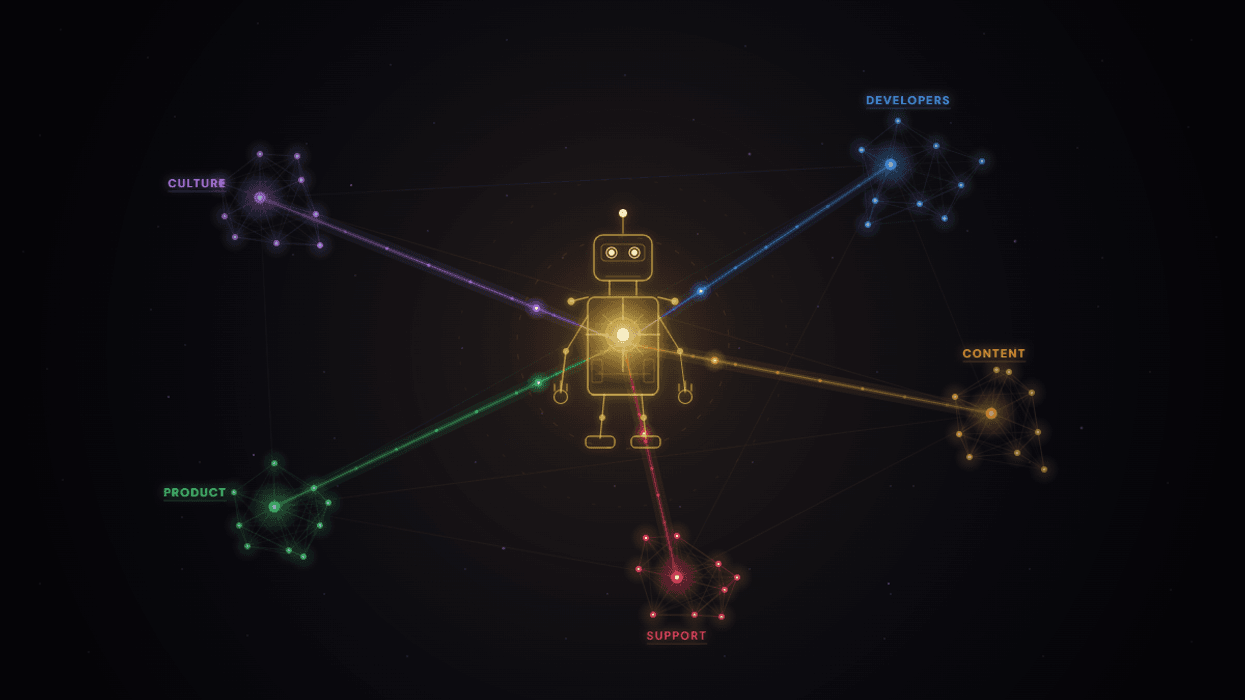
Support teams uncovered workflow fixes. Content teams found things to automate. Employees with no technical background built surprisingly creative prototypes. AI quietly blurred the lines between departments in ways nobody had planned.
People became builders no matter what their title said.
That cultural change, more than any single feature or tool, turned out to be the most lasting result of the whole shift.
Moving Faster Without Breaking What Already Worked
One thing stayed clear the whole way through: client trust could never become collateral damage for innovation.
RebelMouse never treated AI as a race to ship flashy features. The goal was steady acceleration, moving quickly without giving up reliability. As development sped up, operational discipline kept pace. Documentation moved in step with the features. QA adapted as things changed. Support improved without losing the human understanding clients counted on.
The result was not chaos dressed up as progress.
It was a more adaptable company, one where AI cut friction, teams communicated faster, and execution improved while quality standards held firm.
That balance became one of the company's clearest competitive advantages.
The Real Benefits and the Real Barriers
Once AI was part of everyday work, the impact showed up across the company, and not only in productivity. It showed up in mindset, in collaboration, and in how quickly the company could learn and adapt.
The benefits that mattered most:
- Faster execution. Ideas moved from a conversation to a prototype in a fraction of the time.
- Stronger collaboration. Experimentation became shared instead of siloed.
- Broader creativity. People explored ideas they never used to have time to test.
- Tighter documentation and QA. Features no longer shipped while the docs lagged weeks behind.
- Higher adaptability. Teams grew more comfortable learning new systems quickly.
Maybe the most important one: AI took away the fear of starting. People grew more willing to test, build, and iterate, and faster iteration almost always leads to better results.
The transition was not frictionless, though.
Like any organization being honest about AI, RebelMouse ran into real challenges:
- Employee resistance. Not everyone adopted right away. Some doubted whether the tools were reliable or genuinely useful.
- AI hallucinations. Early outputs could be wrong or misleading without careful human review.
- Data privacy concerns. Teams had to think hard about what information could safely touch outside AI systems.
- Tool fatigue. The AI landscape moved so fast it was hard to tell what was actually useful from what was just loud.
- Infrastructure readiness. Real adoption took more than subscriptions. Internal processes had to change too.
- Cost considerations. Giving teams meaningful AI access meant real spending decisions.
The difference was that these were treated as operational problems to solve, not reasons to slow down or pull back.
That framing mattered.
What Actually Makes AI Adoption Work
Looking back over the whole arc, a few patterns kept deciding whether things worked.
Together they make a repeatable playbook. Not a rigid checklist, but a sequence that tends to compound when you follow it in spirit.
The AI Adoption Playbook
7 Steps to Becoming a Company That Puts AI First
Make AI Directly Accessible
Remove the gatekeeping. Give every team direct access to the tools, not a demo, not a webinar. People adapt fastest when they can try things for themselves.
AccessEncourage Learning in Public
Internal demos, shared discoveries, and open discussions build confidence faster than any formal training program. Make learning visible and contagious.
CultureLet Curiosity Lead Before Process Does
The strongest early momentum arrives before formal structures exist. Resist the urge to standardize too quickly. Let organic experimentation run ahead of policy.
MomentumFocus on Augmentation, Not Replacement
AI works best when it amplifies talented people, not when it is positioned as a substitute for them. Frame every use case around what AI helps people do better.
MindsetNormalize Experimentation Across All Teams
The most valuable ideas come from informal experiments in unexpected departments, not just engineering. Build a place where anyone can build and test.
Company WideMove Fast, But Responsibly
Speed compounds only when it is paired with operational discipline. Rapid innovation has to be matched by strong QA, solid documentation, and unwavering client trust.
DisciplineTreat AI as a Skill, Not Just a Tool
Prompting, workflow design, context management, and output evaluation are all learnable. Invest in them. They compound, and they become a lasting competitive edge.
CapabilityThe Biggest Transformation Was Human
Looking back, the biggest shift inside RebelMouse was not technical.
It was emotional.
People stopped seeing AI as something happening to them and started seeing it as something they could shape. That changed the mood across the company, quietly at first, then unmistakably.
Curiosity replaced hesitation. Learning became something people did together. Experimentation became the default rather than the exception.
Most of all, people grew more optimistic about the future instead of more afraid of it. When talented teams are building with technology this powerful, the question in the room changes.
You stop asking: "Will AI replace us?"
You start asking: "What can we build next?"
And that second question is a far better place to work from.
Frequently Asked Questions
What does it mean to be a company that puts AI first?
It means AI is part of how the team works every day, not a side project. At RebelMouse that shows up in both the culture and the product, with AI built into editorial and publishing workflows rather than bolted on afterward.
How did RebelMouse start using AI?
From the ground up. People across teams tried tools like ChatGPT on their own, used AI to speed up headlines, research, and metadata, and the company then built those capabilities into the product through its AI workflow tools.
What were the hardest parts of adopting AI?
The real friction points were employee hesitation, AI hallucinations, data privacy, tool fatigue, infrastructure readiness, and cost. Each one was treated as an operational problem to solve, not a reason to stop.
How can a team start adopting AI the way RebelMouse did?
Give everyone direct access, learn in public, let curiosity lead before process, focus on augmentation, normalize experimentation, move fast with discipline, and treat AI as a skill. If you want a hand getting there, talk to the RebelMouse team.


