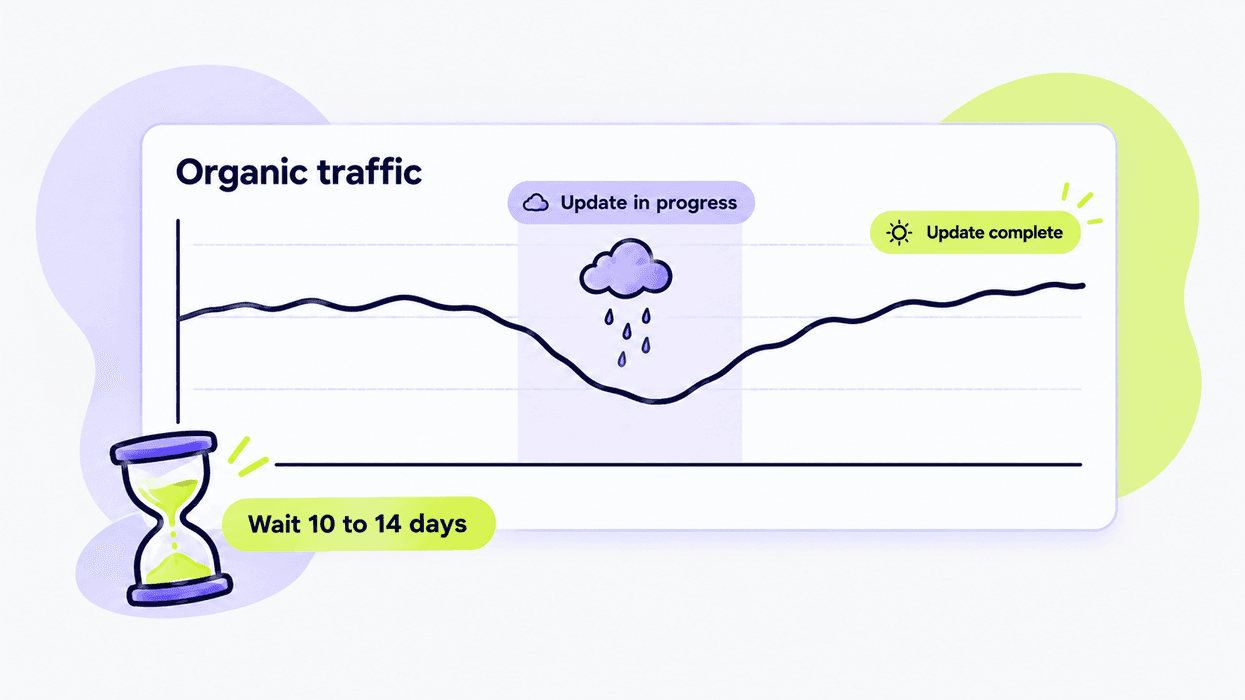

Search Engine Journal published a piece making a case that should be obvious and apparently isn't: You can’t judge a Google update while it's still rolling out. Dan Taylor points to the very recent September 2026 spam update, which didn't finish until October 8, 2026, nearly two weeks after it started, and notes that the worst weekend traffic drops, seen by several well-known SEOs, landed well before the rollout was even done. His advice is specific: Freeze code, redirects, titles, and bulk content changes until the Google Search Status Dashboard shows the update is complete, record dated snapshots along the way, and wait another 10–14 days after that before deciding whether a loss is real. As he puts it, a weekend dip during an active rollout is "a weather report, rather than a post-mortem."
What's notable isn't the advice itself. It's that Taylor has to propose it as a three-stage executive policy, with an agreed freeze period and a structured review gate, because without that formal structure, teams reliably panic and make changes mid-rollout anyway. That's not a knock on any specific team. It's a sign of how little infrastructure most publishers have for separating real signals from rollout noise, and how much that gap costs when someone acts on week-one data that turns out to mean nothing by week three.
Why the Panic Happens Even When Everyone Knows Better
Almost every SEO team already knows, intellectually, not to overreact to a single bad week. The problem is rarely a lack of knowledge. It's a lack of a credible alternative to acting. When a traffic graph drops and there's no dashboard showing whether that drop matches a known rollout window, no snapshot from before the update to compare against, and no clear signal about whether the update itself is even finished, "do nothing and wait two weeks" starts to feel like a decision nobody's willing to own. Taylor's proposed policy works because it gives a team permission to wait, in writing, from someone with the authority to make that call.
A team with continuous, dated monitoring doesn't need a memo granting permission to be patient. The data already makes the case.
That's the gap this advice is covering for. If a team already has a system logging structural health, Core Web Vitals, and schema coverage on a rolling basis, independent of any single week's ranking swings, the "weather report, not a post-mortem" distinction isn't something leadership has to formally bless. It's visible in the data itself. Here's what changed the week of the update, here's what the trend looked like for the six weeks before it, and here's what's actually different now that the rollout is finished. Nobody needs a freeze policy to see that a one-week wobble sits inside normal variance.
What This Looks Like With the Right Infrastructure Already in Place
RebelMouse's Agentic SEO Optimizer runs that kind of continuous, dated monitoring by default rather than as a project a team has to run during a crisis. It's built to catch structural issues, schema gaps, crawlability problems, and Core Web Vitals regressions as a standing process, which means the dated snapshots Taylor recommends collecting manually already exist before anyone needs them. When a volatile update rolls through, the comparison a team needs, this week against six weeks ago, is already sitting there instead of being reconstructed under pressure from whatever logs happen to be available.
This connects to something we've written about in a different context: Google's own acknowledgment that its AI search measurement is unreliable. Taylor's advice and that post are both responses to the same underlying condition. The data a team is working from during a volatile period is often incomplete, delayed, or genuinely in flux, and the only reliable defense is a second, independently owned source of truth that doesn't share the same blind spots.
A Practical Version of Taylor's Three Stages, Built Into the Workflow Instead of Announced From the Top
Taylor's framework, translated into something a smaller team can run without a formal policy announcement, looks something like this:
- Treat "update in progress" as a visible status, not tribal knowledge. If your team has to ask around to find out whether a rollout is still active, that's a gap worth closing before the next one starts, not during it.
- Keep a rolling baseline, not a single before-and-after snapshot. A single comparison point is fragile. A continuous trend line makes a one-week anomaly obvious without anyone having to argue about it.
- Separate "the data looks bad" from "we've confirmed the loss is real." Those are two different conversations with two different owners, and collapsing them into one is how a team ends up making a permanent change in response to a temporary signal.
The Part Worth Remembering Once This Update Is Old News
Why the Freeze Period Is the Hardest Stage to Actually Enforce
Of Taylor's three stages, the freeze is the one teams break the most, and it's important to understand why, because the reason isn't impatience for its own sake. A code freeze or content freeze during a rollout competes directly with everything else on a roadmap that doesn't care what Google is doing that week. A launch planned months ago doesn't get rescheduled because a spam update happens to be rolling out. A content calendar with seasonal pieces tied to specific dates doesn't pause. The freeze Taylor recommends is correct in isolation and genuinely difficult to hold inside an organization with its own competing deadlines, which is why it needs to be a named, defended policy rather than a best practice everyone nods at and nobody enforces when it actually costs something.


