

If you thought Google Search’s 2024 core updates were a rollercoaster ride, welcome to 2025. You might have thought that the future was only focused on AI, but you’d be wrong. Google is embracing an era when humans might actually come out on top over bots.
Last year, Google Search’s core updates were intense, with major core updates dropping in March and August that left entire content strategies filled with holes. But here in mid 2025, we’re seeing a much clearer picture: Google is no longer just indexing content, it’s also evaluating trust.
The days of gaming the algorithm with keyword density, shallow listicles, and “ultimate guides” filled with filler are fading (fast). What’s taking their place? Thoughtful content written by people who actually know what they’re talking about, and who care enough to share it in a meaningful way.
We’ll break down exactly what’s working in 2025 SEO. We’ll give you a heads-up on what signals matter the most and how to structure your content for results. Also, we’ll touch on what to avoid so you can survive Google Search’s core updates.
But for now, the takeaway is simple, and what you should be focusing on is the following:
If your content doesn’t feel like it was written by a human, for a human, Google won’t treat it like it was, and your website is in trouble.
Google Search’s 2025 Core Updates Explained
The latest June 2025 Core Update has doubled down on the trend of being human. According to Google, the focus is on surfacing truly helpful content, which is corporate speak for if your content doesn’t help real people solve real problems, you’re toast and your site has lost its top ranking (i.e., fallen into internet oblivion). That means AI-written fluff, reworded Wikipedia entries, and SEO-churned nonsense are being pushed down.
And then there’s Google Discover, which just added AI-generated summaries to certain content previews, a move that has publishers sounding the alarm. Why?
Google is now taking your human-written content and website, summarizing it with AI, and presenting it before users even visit your site. If the summary is “good enough,” which Google creates using your hard work, then guess what? Fewer clicks for you and less traffic.
If you’re creating content in 2025, you need to stop thinking like an SEO and start thinking like a human. For well over a decade, everything has been driven by SEO. You needed to be an SEO expert to ensure that your site ranked well. However, nowadays you need to also be a creative, skilled human (not an AI bot) writer who can present the facts in a way that benefits the reader.
That means:
- Write from a real lived experience. If you haven’t used the product, walked the process, or lived the moment, then don’t fake it because it's not going to come across as a genuine, real-life experience. Google’s ranking system now favors firsthand perspectives over generic summaries.
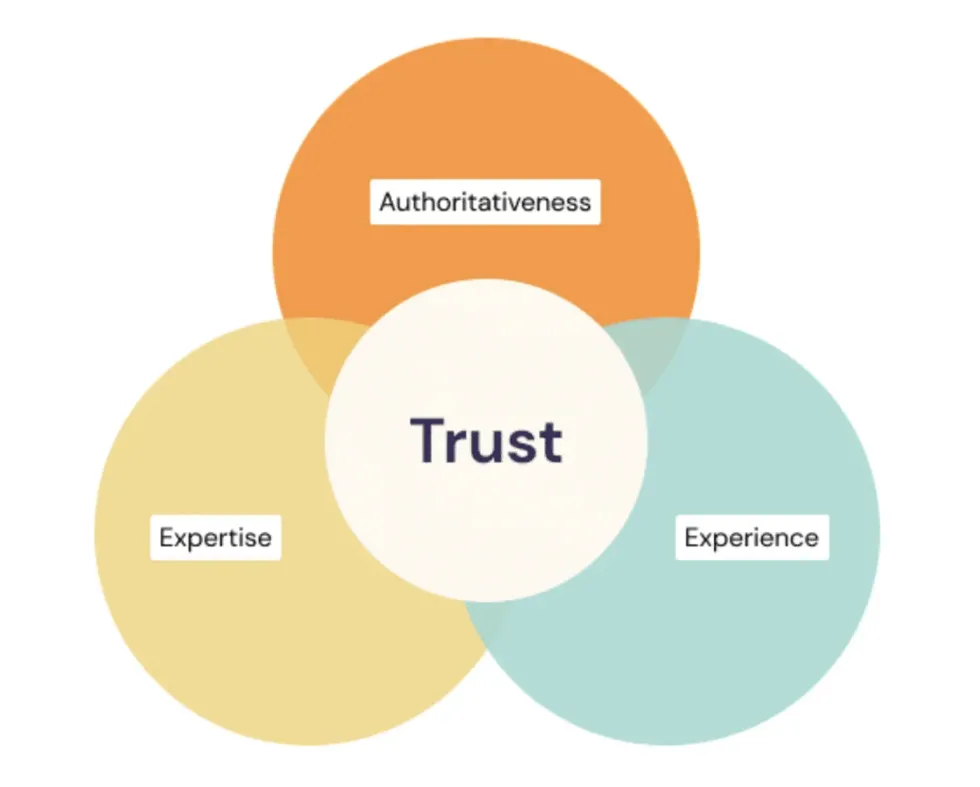
- Stop hiding behind anonymity. Authorship matters. Who wrote the piece? Are they a real person? A writer with the experience to back themselves as experts? You need a name, a bio, credentials, and maybe even a photo. E-E-A-T (experience, expertise, authoritativeness, and trustworthiness) is not just a buzzword anymore — it’s the filter Google uses to decide if you’re worth ranking.
- Show your receipts. Link to your sources (and make sure they’re respected and not some fly-by-night site). Include evidence. Quote real people. Use original photos. In 2025, "just trust me" isn’t a content strategy; instead, for Google, it’s a red flag.
With Google Search’s core updates, even smaller sites and solo bloggers are outranking legacy media if their content feels personal, original, and useful. Google is shifting away from scale and toward signals of sincerity and expertise. If you’re trying to compete with a mass-content approach, you’re already behind.
In short: Google wants real content from real people.
Google Ranks Content Like a Human

In the past, a well-placed keyword and a few H2s might’ve been enough to get you noticed and push your site to the top of the search results. However, in 2025, Google's algorithms act less like a bot and more like a human.
Things like how easily your content answers important questions matter. They also look at exactly how long someone sticks around to read the article. If they land on it and immediately navigate away to another page, then there’s a problem and Google is going to take notice.
You need to have visual clarity, smart formatting, and intentional UX design to ensure good rankings. If your introduction buries the answer to the query, then your site is going to be penalized.
Sites that fail to organize their information clearly, have smart internal linking, and solve the reader’s problem are going to take a hit.
Your content should read like a helpful conversation to rank well in 2025.
Content Creation in the AI Age
In 2025, AI tools are everywhere. Yes, they create content fast, but Google can quickly spot mass-generated content that was written by AI. Content that ranks well is written by real people who use AI as a tool, but not as the sole writer.
You can use AI to outline an article, organize your sources, and streamline your repetitive tasks, but you should still write the content yourself. Share your opinions and experience. Put a genuine voice to your work.
The Fall of Thin Content: Why Generic Doesn’t Rank
Google Search's algorithm in 2025 is smarter and extremely picky. It actively penalizes content that feels thin, recycled, or was written just to "rank." If your blog post doesn’t add something new to the conversation, it’s getting skipped in favor of someone who actually knows what they’re talking about.
- Did you offer something nobody else has?
- Did you explain it in a way that actually helps the reader?
Answer “no” to either question and, guess what? You’re out!
Even listicles aren’t safe anymore. If your “Top 10 Tips” could have been written by a chatbot in 30 seconds, Google knows and (hopefully you’ve guessed it by now) you'reout!
2025 and Beyond: Strategies That Work
Fast-forward things to the next level so you can continue to ensure that your site ranks well. What is working in 2025? Things have changed a lot in the year because the use of and dependence on AI have grown substantially. There is no denying the fact that AI is here to stay, so you’ll need to learn how to use it, but not overuse it.
We want your site to rank, so let’s examine some strategies that are still working in 2025.
Keep People First, Always
Google’s messaging is clear: Algorithms are tuned to reward user-first content. So, what can you do to keep people first?
Your content can meet these needs:
Answer Questions
- Offer context.
- Cite reputable sources.
- Use real-life examples.
Think of each article as a conversation, because that’s what ranks and it’s what people like to read. People crave human interactions, even in the written word, so write to the reader like you would talk to your best friend.
Beat the Competition With Originality
AI overviews and aggregators are creating generic summaries. It’s more important than ever before to stand out as truly human in your writing. Make things original and give the reader things that they want and need. Start by answering their questions with an interesting introduction that isn’t dry.
Stand Out From AI by Doing the Following
- Offer niche or advanced insights.
- Create personal stories, interviews, or unique data.
- Ensure content is actionable and memorable.
Google Discover’s AI Summaries: Should You Be Worried?
There’s something that has a lot of people worried: Google Discover’s AI summaries. Should you be worried? Yes and no.
In July 2025, Google started testing AI-generated summaries inside Google Discover, which is the content feed you see on mobile before you even search. These summaries pull snippets from your content and display them before the user clicks.
On the one hand, it could boost engagement. On the other, it could replace the click entirely. If Google gives users everything they need in the summary, why would they visit your site?
People increasingly have a very short attention span, and if they get the answers they want fast through the snippet, then they’ll more than likely not continue on to your site. Without a doubt, that’s a big concern, and it’s valid.
So, what can you do about it?
- Make your intros irresistible. Hook people so they want to click, even if they see a preview. How can you do that, you ask? Do not write something mundane or boring. Turn to a skilled, creative writer to create your introductions. The writer should know the magic of the hook and use it to its fullest potential to grab the reader’s attention.
- Use original visuals. Google can’t summarize those. Humans are visual by nature, so use that to your advantage.
- Deliver value that can’t be condensed. People want to connect. The written word has always been about reaching out to people, so make use of its magic by sharing real-life stories, analysis, and nuance.
If your content can be summed up in two lines, don’t be surprised when Google does exactly that, and the cold-hard fact is that it takes the traffic with it.
The Rise of Small Creators and Niche Experts

You don’t need to be a massive publisher or a million-dollar brand to win anymore when it comes to ranking across Google Search.
Many of those big sites are losing rankings to solo creators, small blogs, and niche experts who just know their stuff. Why? Because the writers working for those small sites are writing from experience. They’re not trying to churn out 20 articles a day. Instead, they’re focused on quality, trust, and depth. That takes time, skill, expertise, and real-life experience.
Google is now truly rewarding creators who are embedded in their topic. This is your opportunity to shine.
Don’t chase scale — chase sincerity. Whether you’re writing about SEO, parenting, gaming, woodworking, home improvement, or dog training, write from lived experience. That’s what wins in 2025 with Google.
Surviving the Next Google Search Core Update
You don’t need a full rebrand or a technical overhaul to survive Google Search’s next core update in 2025. However, you do need to take content quality seriously.
Here’s where to start so you can survive the next Google Search core update:
Audit Your Content for Trust Signals
If your site is full of “ultimate guides” with no author names, no sources, and no unique insights in each piece, then start there. We suggest that you add bios. Link to reputable sources. Include photos, case studies, and even screenshots. Make the blog post or article feel like it was written by a real person, not a bot.
Refresh Stale Content
Update old posts with new data, better formatting, and improved structure. Yes, you can breathe life into old writing (even if you used AI). Google rewards freshness, but only if it’s actually useful and not just an updated publish date. You need to take the time to have a skilled writer put a genuine spin on things and make it useful.
Cut or Consolidate Weak Pages
Okay, it’s time to be honest with yourself about each piece of content on your site. If a post gets no traffic, has no backlinks, and brings nothing new to the table, you’re better off merging it into a better-performing piece or deleting it altogether. Thin content is going to weigh down your entire domain and make your site suffer, so get out the scalpel and start cutting it away a piece at a time.
Prioritize Topics You Know
Write what you’re qualified to write about. Don’t chase high-volume keywords in niches you barely understand. Google’s smart enough to tell when you’re out of your depth in an article, so stick with what you know.
Get Feedback From Real Humans
Ask someone to read your content and tell you if it feels helpful. Not “optimized.” Not “long enough.” Just genuine, real, and helpful. At the end of the day, that’s what matters and what sets a human-written article apart from something produced by AI.
Human + AI = Smart Combo
It’s true, AI is a fantastic tool, and you should not completely pass it by. Use AI as a tool to improve your writing and your website. Don’t use it as the sole creator of everything.
Use AI for the following functions:
- Generating optimized headlines
- Creating outlines and draft flows
- Building internal tools (e.g., chatbots, archive summaries)
However, even though AI is fantastic, you should still always have humans revise, fact-check, and add a distinct voice to whatever you’ve created for your site.
Monitoring and Flexibility
With core updates still frequent, be ready to pivot:
- Monitor Google Search Console, analytics, and tools for ranking or traffic shifts.
- Set bi-weekly review sessions.
- Be ready to adjust focus, trim thin content, or enhance top performers.
Visual-Driven Signals
Google’s image and visual systems have improved dramatically in 2025. They can now analyze your content layout, examine clarity, and even look at color schemes.
Use clear, relevant images with proper captions and structured data. Lazy auto-image generators won’t cut it. You want your visuals to be cutting-edge and truly grab attention. Now is the time to think about how a visual can complement your work and boost it when needed.
Authority Signals Beyond Links
Link equity is important, but now, reputation (e.g., social mentions, citations, events, partnerships) influences rankings indirectly. Ideally, you should place citations and more in your content to gain the little push you’ll need to keep ranking well.
Feature expert guest posts, speak at events, and get legit coverage in podcasts or trade publications.
The Future of SEO Feels More Human Than Ever

If you take anything from this article, let it be: Google’s updates are built for users, not bots. Yes, humans still matter, and it’s not just about AI. Google doesn’t just want content, it wants connection.
The winners in this future game aren’t writing for search engines anymore. They’re writing for readers. And Google’s finally caught up with that reality.
Treat your site like a living thing. Make sure to adapt, evolve, and keep things centered on people. Do that, and Google Search’s algorithms will award you the visibility and momentum you deserve. Give your writers the freedom to be creative, write from the heart, and proudly showcase their experience. Cite your sources and make your content so good and filled with genuine emotion that AI can’t replicate it.
In our opinion, that’s how you survive the next core update. And the one after that, too.
Need help staying ahead of Google Search’s algorithm changes? RebelMouse combines cutting-edge tech with expert strategy to keep your content ranking. Reach out to us today to learn more.


