
Every publisher and marketing team we talk to right now has the same dashboard open: How many times did ChatGPT, Gemini, Perplexity, or AI Overviews mention our brand this week? The number goes up, and it feels like progress.
But it isn't. Not on its own, at least.
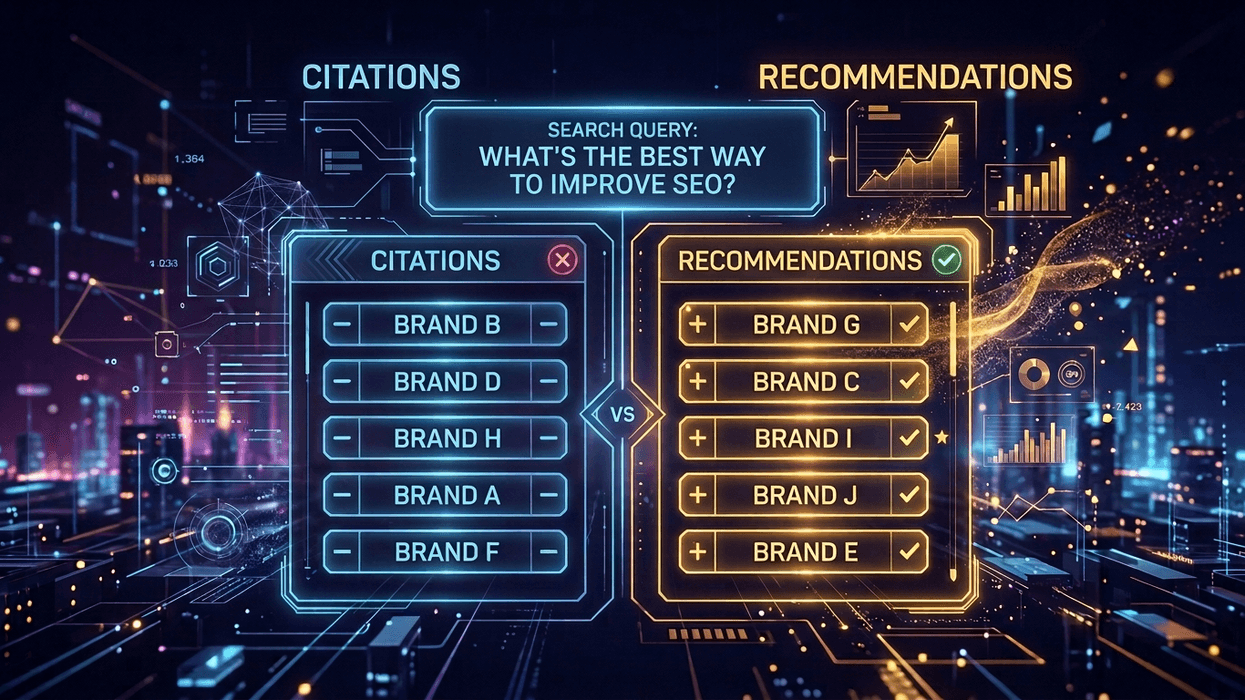
Search Engine Journal made this point recently, and it's worth diving into. Citation counts and recommendation counts are two completely different things, and the gap between them is widening, not closing. Being mentioned isn't the same as being chosen. An AI system can cite your page as one of six sources in an answer and never actually point a user toward you. You show up in the footnotes while someone else gets the click, the sign-up, and/or the sale.
Why This Confusion Happened
It happened because citation counting is easy and recommendation measurement is hard. You can query an AI system, log which domains it references, and build a tidy chart. That chart looks like proof of AI-search performance, so teams optimize for it and vendors build products around it. In fact, an entire category has sprung up in the last year almost entirely around counting appearances in AI search results.
But counting appearances was never the goal. The point was always, “Does the AI system's answer make the user come to you, act on your information, or trust your brand a little more than they did before?” A citation can do that, but it frequently doesn't.
This is the same mistake the SEO industry made with keyword rankings a decade ago. Ranking #1 for a keyword nobody clicked on was never a win. It just felt like one because it was measurable. AI visibility is repeating that pattern in compressed time.
What Actually Separates a Citation From a Recommendation
Three things distinguish a citation that drives real outcomes from one that doesn't, and none of them show up in a simple mention count.
- Specificity of attribution. A citation that names your brand by name, in the sentence a user actually reads, is worth more than one buried in a source list at the bottom of the response. If an AI answer says "according to [Your Brand]," that's a recommendation. If it synthesizes your data into a generic sentence and lists you as source #4 out of seven, that's a citation with none of the trust transferred.
- Actionability of the mention. Does the AI's answer give the user a reason to click through to your site, or does it fully resolve their question without you? A recipe site cited for a technique that gets fully explained in the answer gets nothing. A product cited as the thing to buy, with a reason attached, gets a customer.
- Structural trust signals feeding the model. This is something that isn’t being measured enough, and it's the part we can actually control. AI systems weight sources differently based on structured data, author expertise signals, content freshness, and crawlability, which are the same fundamentals we've been writing about all year. A citation earned through strong E-E-A-T signals and clean structured data carries more weight in an AI system's downstream reasoning than one scraped incidentally from a page with none of that scaffolding in place.
Why We’re Not Surprised
We've spent this year building the case, piece by piece, that AI visibility isn't just a bolt-on feature, and how it's a byproduct of doing the fundamentals right: clean structured data, deliberate crawler governance, content built for citation rather than mention. Watching the industry now realize that counting citations was never the real goal doesn't change our approach. It actually validates it.
But here's the uncomfortable part for a lot of teams: You cannot buy your way out of this with a generative engine optimization (GEO) dashboard. A tool that tells you how many times you got cited last week is diagnostic, at best. It can't tell you whether your content was built the way that earns a recommendation instead of a footnote. That's a judgment call about what you publish, how you structure it, and whether it's actually the most useful answer to the question someone asked. It’s not a metric you can outsource to a monitoring subscription.
This is exactly the belief we keep coming back to, that execution is abundant now. Anyone can publish more, faster, with AI doing the heavy lifting. What's scarce is knowing whether what you published deserved to be the answer at all. A citation-counting tool measures the former. It has nothing to say about the latter.
What to Actually Do About It
Stop treating citation count as a KPI on its own. Track it, but pair it with a harder question for every piece of content you publish. If an AI system used what you’ve written as a source, would a user reading the synthesized answer still need to click through to you?
- If the honest answer is no, you've written something that will get cited and forgotten.
- If the answer is yes, you've written something with a reason to survive contact with an AI Overview.
Build the structural fundamentals before you build the reporting layer on top of them. Structured data, clean author attribution, crawler access that actually lets the right bots in and keeps the wrong ones out. Get those right first. A monitoring tool applied to poorly structured content just gives you a very precise count of how often you're being overlooked.
The Real Shift Underway
We'd rather be ahead of that correction than chasing it. That's why we've built AI visibility work around the fundamentals, such as structured data, crawler governance, and content built to earn a recommendation, instead of a dashboard that tells you how often you got mentioned in someone else's answer.
Being cited is easy, but being chosen is the priority.


