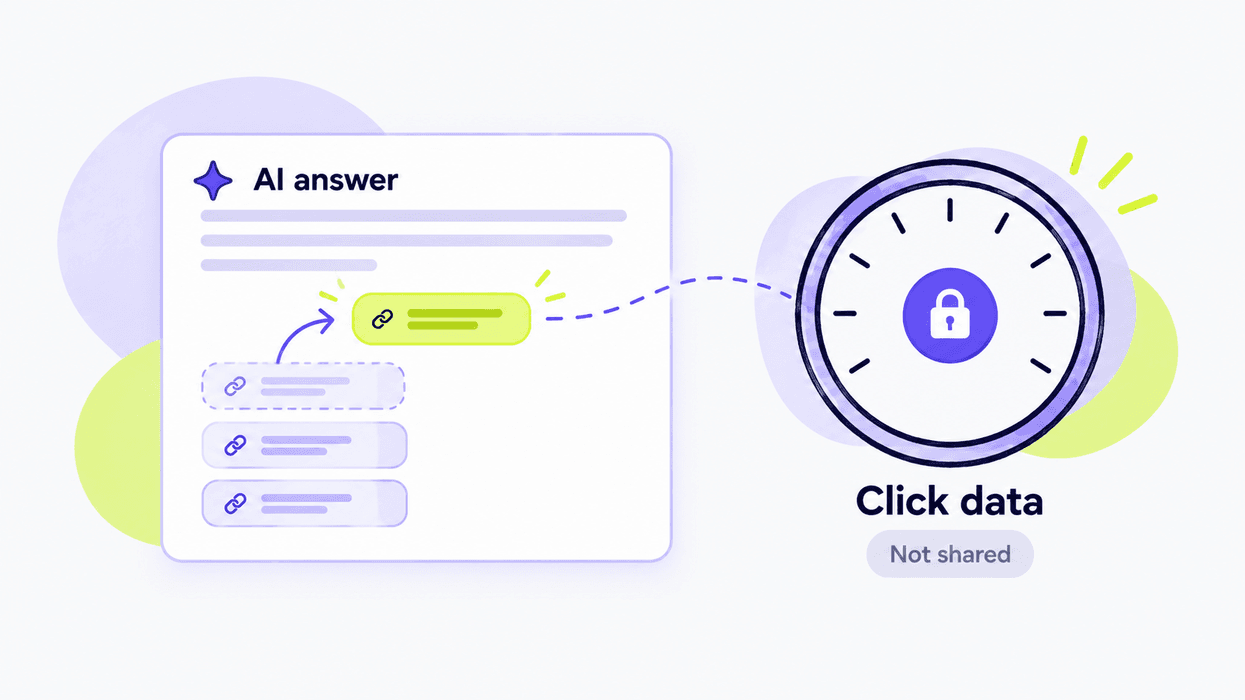

On October 15, 2026, Search Engine Roundtable reported that Google has once again changed how links behave inside its AI Mode and AI Overviews. It's the latest in a string of adjustments to those surfaces over the past year. Click-through data from AI Mode and AI Overviews is still something Google chooses whether to disclose. Publishers can't pull it themselves.
In short, publishers still have no way to see what those changes did to their own traffic.
What Changed This Time
A report published the same day laid out the specifics. Google is placing inline citation links higher in more AI search responses and giving them more visual weight. The "Preferred Sources" carousel, the module that decides which publishers get prominent placement inside an AI answer, is expanding to cover more query types. Google is also testing links that run from a brand's official site, or from a named creator, straight to that creator's Search profile on Google's own domain. But none of these changes ship with an updated dashboard that tells a publisher what happened to its own traffic as a result.
The creator-profile test carries a real implication for publishers on its own. If Google starts routing identity and attribution through its own Search profile pages rather than a publisher's own byline and site, publishers become more dependent on Google's infrastructure for something as basic as being recognized as the source. More prominence shows up inside Google's interface, and less of that relationship lives on a publisher's own site.
Two days later, on October 17, 2026, a roundup of search industry data added a number that’s worth pairing with that gap. Roughly 8% of tracked search results pages were showing distorted or unreliable results, according to the rank-tracking data cited. Google kept surfacing more inline links in AI answers during the same stretch, with no new way for publishers to measure what those links actually produced.
The surface keeps moving, but the tools publishers would need to track that movement stay still.
A New Chapter, Not a Repeat
We covered a related story in a post published back on September 17, 2026. That piece was about Google essentially admitting that Search Console's own reporting can't keep up with how AI Mode and AI Overviews actually work. This one is different though. It's about the link behavior Search Console is supposed to be measuring, and that behavior changed again in October, in a specific and documented way, while the reporting gap stayed just as wide as it was in September.
In September, Google told us its own instrument panel for AI search was incomplete. In October, Google kept redesigning the game while that panel stayed just as incomplete. The second admission matters more for anyone running a publishing business today. This looks less like a temporary bug and more like the operating condition for AI search measurement, and it's reasonable to plan on it staying that way for a while.
Why "Wait for Google to Tell You" Is a Losing Strategy
Here's the mechanical problem. Every time Google changes link placement, carousel eligibility, or profile linking inside AI Mode, it resets the baseline publishers are measuring against. A traffic dip after October 15 could mean a publisher lost citation share. It could also just mean Google rearranged the links and nobody was told. Without click data from Google itself, there's no clean way to tell those two situations apart.
We flagged a version of this failure mode in a post published September 9, 2026. That piece argued that counting AI citations tells a publisher almost nothing about whether a citation sends anyone to the site. A citation sitting inside an expanded Preferred Sources carousel can read as a win in a rank tracker and still produce zero sessions. Google changing where that carousel appears, and how often, without changing what it reports on the back end, widens that blind spot.
A publisher relying entirely on Google's own dashboards for this answer is structurally behind Google's own product roadmap. A publisher learns AI Mode changed after a journalist reports it, days after the fact. A publisher learns what the change did to its own traffic almost never, because the one party holding that data has already decided not to share it.
Does more inline linking mean publishers get more traffic? Nobody outside Google can say with any confidence. More links placed higher in an AI answer could mean more clicks. It could also mean more visual competition for attention inside that same answer, or a reader who scans the carousel and never clicks anything at all. The honest answer is that the publisher asking the question has no first-party way to check.
Measure Your Own Readers
AI has made it almost automatic to get surfaced in more places, more often, with less work than ever. Whether it’s a link inside an AI Overview, a slot in a Preferred Sources carousel, or a citation in a chat answer, all of that distribution keeps getting easier to earn. What stays scarce is the ability to tell whether any single piece of it actually works for a specific publisher, on a specific day, after a specific Google change.
That's the gap our agentic tools are built to help close. Instead of waiting on Google to decide what to disclose about AI Mode traffic, our tools give publishers their own first-party read on what happens after an AI surface sends a reader toward a piece of content: where that reader lands, how far they get, and what they click next. That's a signal a publisher owns outright, and it doesn't reset every time Google changes how a link renders.
This matters more the more often Google touches these surfaces. If link placement inside AI Mode had settled into something stable months ago, a publisher could reasonably build a mental model around Google's own reporting and trust it to hold. But it hasn't settled. Schwartz's October 15 reporting is explicitly about another change to link behavior, and the October 17 roundup shows no sign that that pace is slowing. A publisher's own measurement layer is the one part of this system that doesn't reset on Google's schedule.
What to Do This Week
The following moves beat a wait-and-see approach:
- Stop treating citation count as the finish line. If a reporting stack still equates getting cited in an AI Overview with success, that's a visibility metric standing in for an outcome metric. Pair citation tracking with actual session and engagement data for traffic that originates from AI surfaces.
- Flag baseline shifts after dates like October 15, 2026, as product changes, not performance changes. When Google adjusts link placement, a publisher's own data should be what decides whether that adjustment helped or hurt, because Google's dashboards won't say.
- Push site speed and crawlability, since those stay fully in a publisher's control. A prior report found site speed to be one of the most critical factors in getting cited at all. Google can rearrange how a citation gets displayed, but it can't make a slow site faster.
- Build the first-party traffic signal now, ahead of the next redesign. Every week spent relying solely on Google's dashboards is another week where the next product change arrives as a surprise instead of a measured event. Given the pace of the past year, there will be a next one to contend with.
The Pattern, Stated Plainly
Publishers waiting for that to change are planning around a condition that hasn't shown up yet, and may never show up. Publishers building their own measurement layer get to answer the question that actually matters after a day like October 15, 2026. Not what Google changed, but rather what happened to their own readers because of it.


