

Subscribe to Our Newsletter

x

How to Know You've Got Viral Content Before It Happens

Velocity Alerts put your content on the fast track to viral success!

It's awesome when your content takes off and starts to go "viral." First, let's define what it means to produce viral content. We define the term "viral" as when traffic from another website or source, such as a social platform, begins to increase in addition to engagement from site visits. But what if you could know the moment your content starts trending so you can take advantage of the momentum and push it even further?

This is where Velocity Alerts, unique to our platform, come into play. With Velocity Alerts, your team is notified when a post starts to trend so you can "add fuel to the fire" by featuring the post more prominently on your site, triggering newsletter alerts, or promoting on social.


How Velocity Alerts Work

Velocity alerts are automatically emailed to you, and they're determined by tracking how quickly your content is being engaged with on your site, as well as on social networks that you've connected to your RebelMouse account.

  • When you post content, we monitor the average engagement for the first minute, every minute for the first 10 minutes, every 10 minutes for the next two hours, and every hour for the next 24 hours.
  • We track performance compared to the time of day and the day of the week, so content that's published during a time or day that typically has low engagement rates can be detected early.
  • We show on which social network (e.g., Facebook, Instagram, etc.) your post is going viral and by how much it's over performing.
  • We allow you to quickly optimize by giving you the option to feature the content on your site and/or send out an email blast about it.

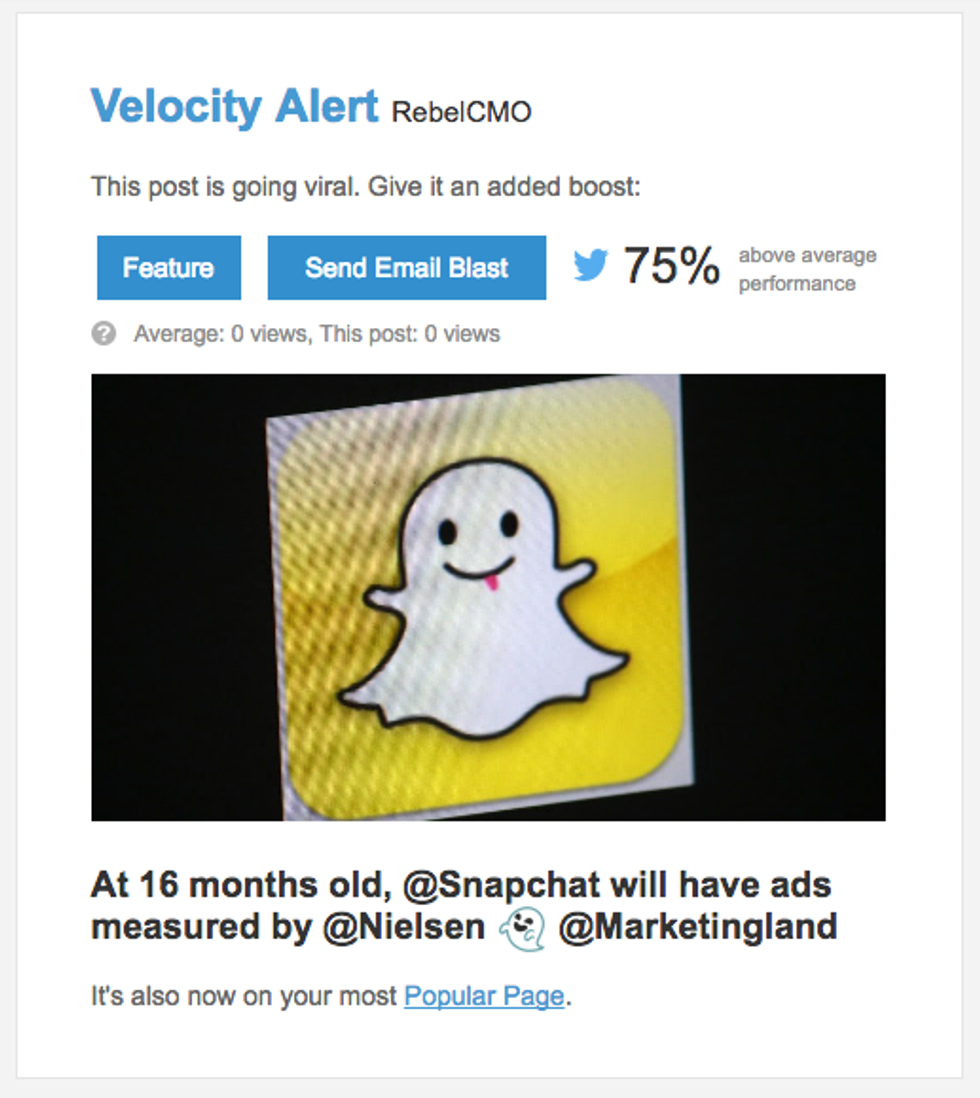
Here's an example of a Velocity Alert for a social post:

What You Should Do When You See This Alert

Velocity Alerts are intended to point out that a piece of content is gaining popularity fast, instead of just waiting until it's become so popular that it would be hard for your editorial team to not notice.

Once you receive a Velocity Alert, there are a handful of things you should do:

  1. Consider boosting the post on social. This is the best time to spend a little money on a viral hit.
  2. Consider sending out an email blast about it — it's working with an audience that you're already reaching and you might be able to amplify it.
  3. Consider doing an ICYMI (in case you missed it) follow-up post on social. It's a great strategy to reach new audiences that may have missed the post during its initial rise.
  4. Consider spending some time emailing the link to the post to key traffic partners and outlets.

Here's an example of a Velocity Alert for a site post, with key benchmarking data:

Getting the right information early is critically important when creating a viral hit. Velocity Alerts can give your team the advantage by getting you the information you need early, allowing you to get the most out of your content.

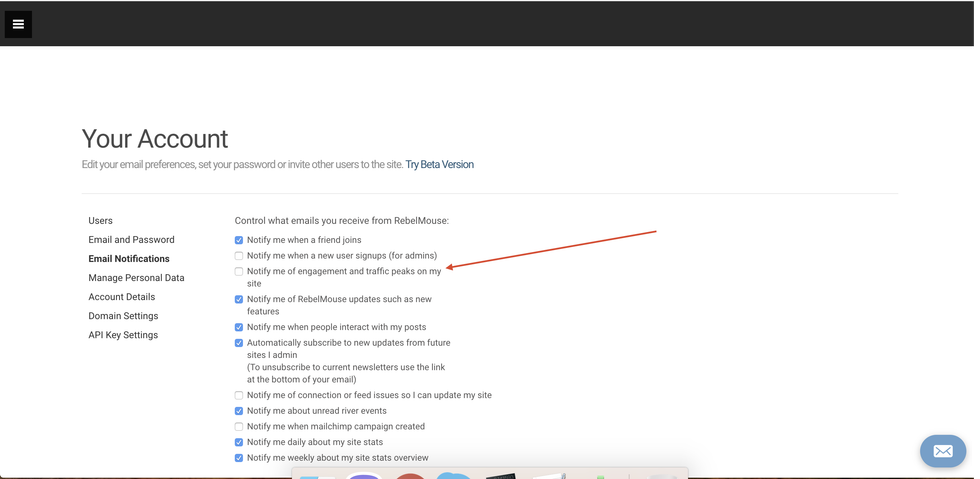
How to Set up Velocity Alerts

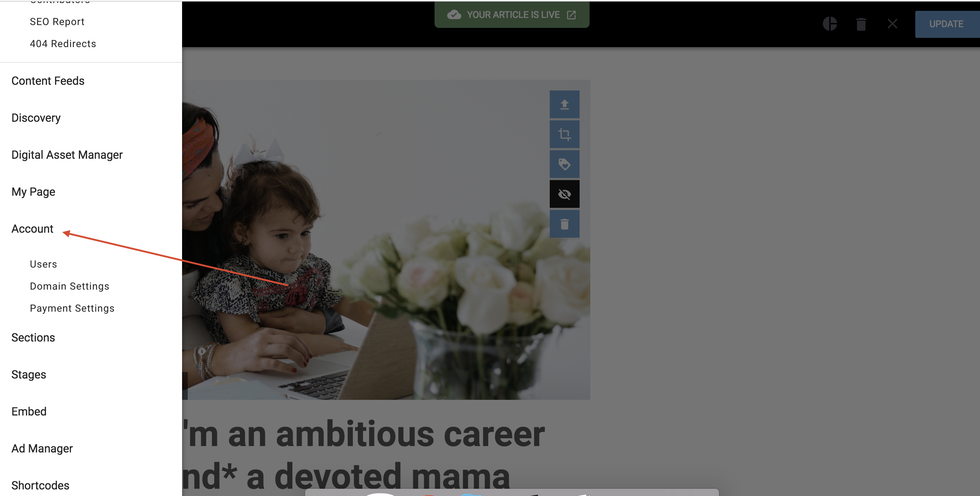
Step 1: Head over to your Account dashboard via the hamburger menu (☰).
Step 2: Click on Email Notifications.
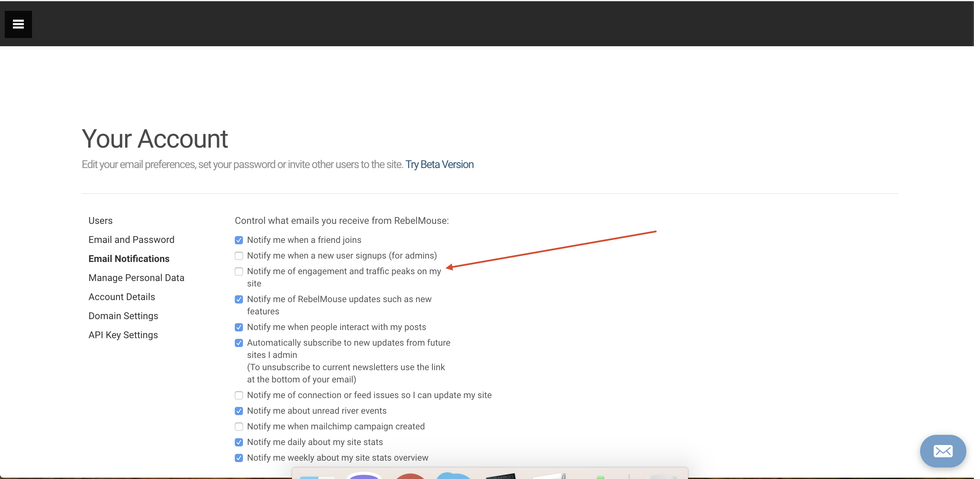
Step 3: Click the checkbox titled Notify me of engagement and traffic peaks on my site.
If you have any questions about this feature, email support@rebelmouse.com. Happy viral moments, Rebels!

Related Article

Understanding Subscriber vs. Signup Terms in Daily Stats Email

Particle Assembler: Ads in Slideshows Now Supported

You can now insert ads between slides in a slideshow!

Monetizing users' engagement and page views is pivotal to most digital businesses, and our Particle Assembler has been an invaluable tool in helping RebelMouse clients to insert native ads seamlessly into their content. Now we've taken this functionality one step further by introducing support for ads between slides in Assembler's slideshow layout.

Keep reading... Show less

Inside RebelMouse’s Quality Assurance Operations

How We've Perfected Stress-Free Publishing

At RebelMouse, we like to refer to our enterprise publishing platform as "lean tech." Most publishers have a natural inclination to start doubling down on teams of developers who try to build unique experiences to help stand out above the noise. But they should actually be doing the opposite: Lean tech is the preferred way to cut through content saturation. By allowing RebelMouse to obsess over your product, content producers, editors, managers, and everyone in between can focus on creating quality content and taking advantage of opportunities to leverage distributive publishing strategies that create real revenue growth.

One of the major reasons we're able to maintain a lean tech environment is thanks to our approach to quality assurance (QA). We make updates to our platform daily to ensure our clients always have access to the most robust, high-performing, and secure version of our platform. Behind the scenes, this means having a solid QA structure that's efficient, creates less bugs, and catches the ones that do pop up before they go live. It's a system of checks and balances that's hard and costly to replicate on a custom CMS. Here's a glimpse into how it works.

Our Tech Stack Toolbox

  • Cucumber
  • Java
  • Junit
  • Maven
  • Selenium WebDriver
  • TeamCity
  • Zalenium (Selenium Grid)

Our Checks and Balances Workflow

Automated Regression Testing Cycle

The Lifecycle of a Product Update

When an update is first made to RebelMouse, TeamCity immediately triggers the start of automated tests to review integrity.

TeamCity Build

TeamCity Agent

The tests run in parallel on TeamCity's Build Agent. Next, Zalenium creates docker containers with browsers that matches the count of parallel threads. An Allure report is then generated from the test results, which shows the state of the application after the update.

Allure Report Pass

If a test doesn't complete successfully, the testing framework receives a video with a failed test and attaches it to the Allure report.

Allure Report Issue

Based on the report analysis, a QA specialist will create a "bug" ticket in our product management software to address the issue if needed. Then, information about the bug is immediately sent to the project manager and we begin the process of correcting the problem.

The media powerhouses we power can publish with confidence knowing that any product issues that arise are met with a tried-and-true process to fix the problem with little-to-no disturbance to their workflow. If you have any questions about this process, please email support@rebelmouse.com.

Related Articles

Related Posts vs. Posts in Assembler

Here's the difference between Related Posts and Posts in Assembler.

By using Related Posts and Posts in Assembler, you can help your audience stay engaged with your site's content and generate more traffic. Both of these features can be added to any post through Entry Editor.

When creating or editing a post, you can add a Related Posts section to the bottom of it that consists of a selection of existing posts on your site that you choose to surface. Only the main image and content headline are pulled, along with a link to the original post. This is similar to the Around the Web section that also shows up at the end of your post when you enable it from the SEO tab of Entry Editor.

Keep reading... Show less
Subscribe to Our Newsletter