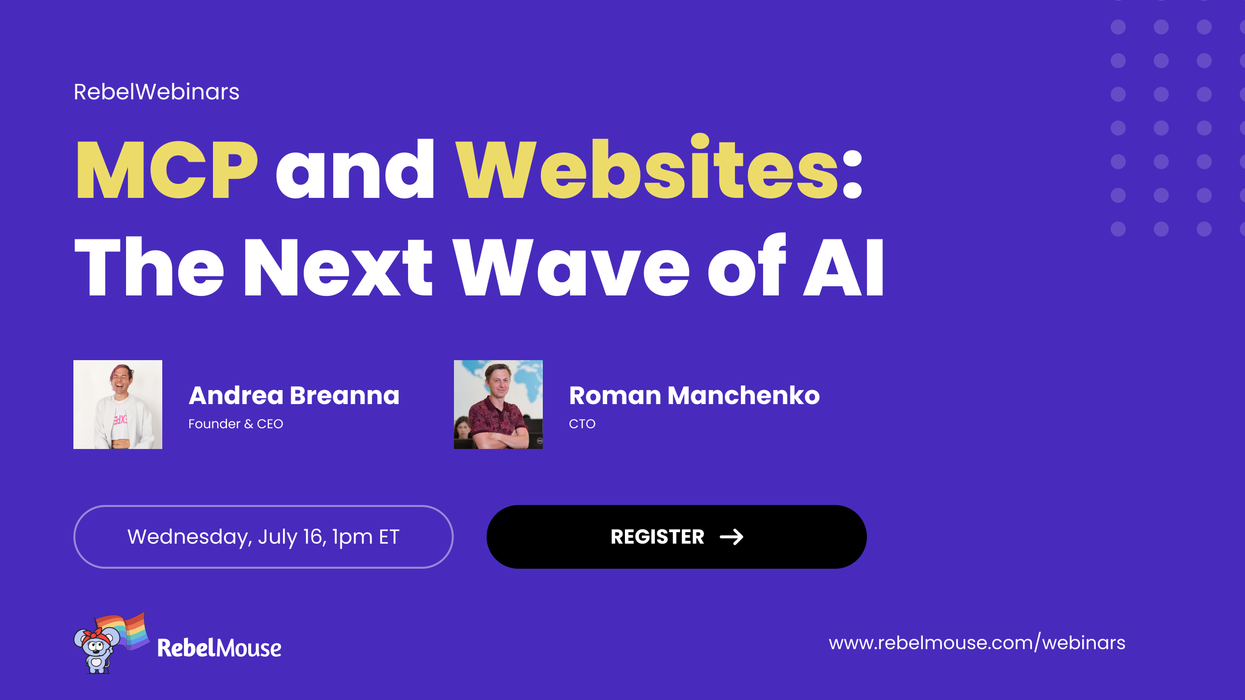

RebelMouse's CTO Roman Manchenko presented an exclusive webinar on the future of websites in the AI era.
The webinar focused on Model Context Protocol (MCP), a new open standard created by Anthropic that allows AI applications to securely access external data sources and functionality. A recording of the video is available by request by getting in touch here.
Key takeaways from the presentation include:
- What Is MCP? It's a model context protocol that lets AI applications securely access external data sources, functionality, and tools, abstracting large language models (LLMs) from the complexity of internal APIs. It's envisioned as a new REST API protocol, enabling different systems to communicate in a shared language.
- The Problem MCP Solves: Current AI assistants can answer questions and perform creative tasks, but they are limited in real-world applications and lack the ability to perform operations on a user's behalf safely and efficiently. MCP aims to enable universal protocols that LLMs can use to not only access data but also perform actions.
- Current State of Adoption: Introduced in late 2024, MCP has already seen adoption by major players like OpenAI and Google.
- How to Use It: MCP is available for enterprise and organization plans, with RebelMouse and OpenAI offering beta versions. Users can enable MCP through their dashboards and connect to existing MCP servers.
- Benefits of MCP: It allows organizations to deliver more secure and controlled features and functionalities to users. It facilitates real-world actions, such as ordering products through a chatbot, in a trusted environment.
- Risks of MCP: The speaker emphasizes the importance of using remote MCP servers from trusted organizations to avoid security risks, especially regarding application tokens and credentials.
- Creating an MCP Server: There are two types: local and remote. Local servers are more secure as data remains on the user's machine, while remote servers are hosted in the cloud by organizations, offering easier integration for the end user. Anyone can create an MCP server, but organizational servers have broader access to internal data and functionality compared to individual creations limited by public APIs.
- RebelMouse's Approach to MCP: RebelMouse is fully committed to MCP, believing it's crucial for the future of AI. They prioritize safety and security, building their own remote MCP server that is currently used internally. They are also building an LLM.txt format to offer to clients.
- Future of AI Search (Agent-First Web): The speaker believes that MCP will be a huge part of the "agent-first web," where users will interact with software, content, and services through AI agents. These agents will act as assistants, capable of handling various tasks from a single chat interface. This shift is expected to lead to a significant migration from traditional web search to chat-based interactions within 2–4 years.
- Tracking Content Across Google AI Overviews: Currently, there's no way to track with 100% accuracy when content appears in Google AI Overviews. However, Google has announced plans to add clicks and impressions from AI Overviews to Google Search Console.
- Encouraging MCP Adoption: The speaker suggests demonstrating the benefits of MCP to content creators and internal teams, focusing on increased productivity and precise control over AI actions. They also highlight that LLMs can interact with multiple MCP servers simultaneously, enabling complex workflows.


